
Last updated August 25, 2026
Free on-site gate assessment - hinges, posts, and your LiftMaster or Nice gate operator checked before anything is quoted
The assessment is free and the quote is the invoice.

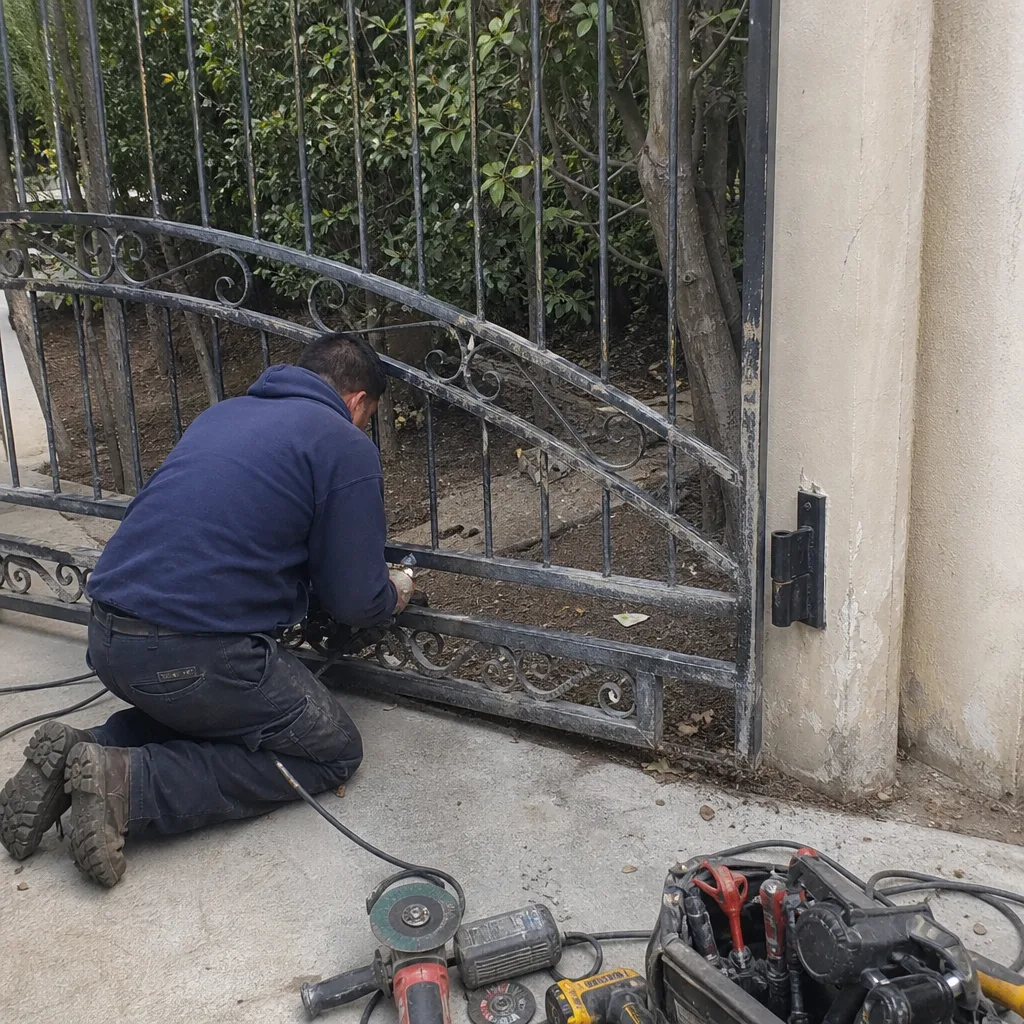 Before
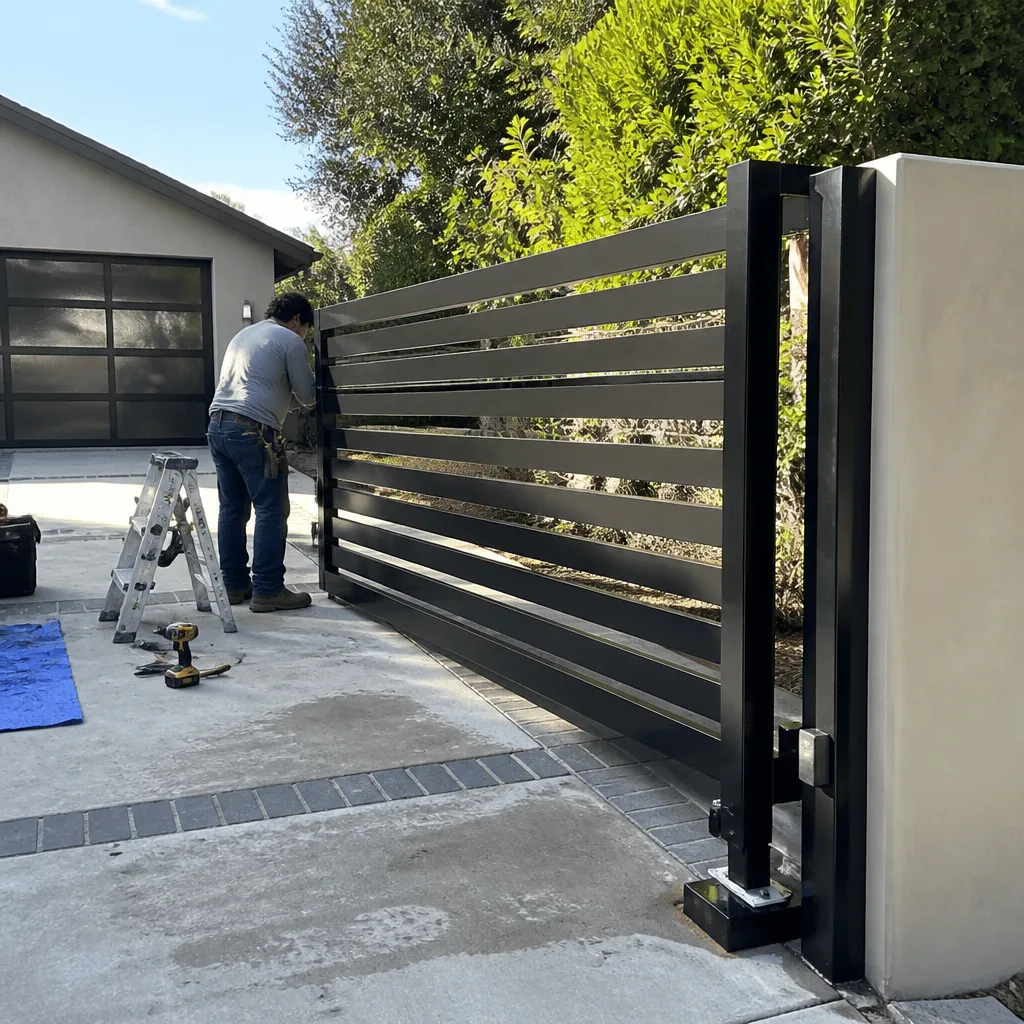 After
After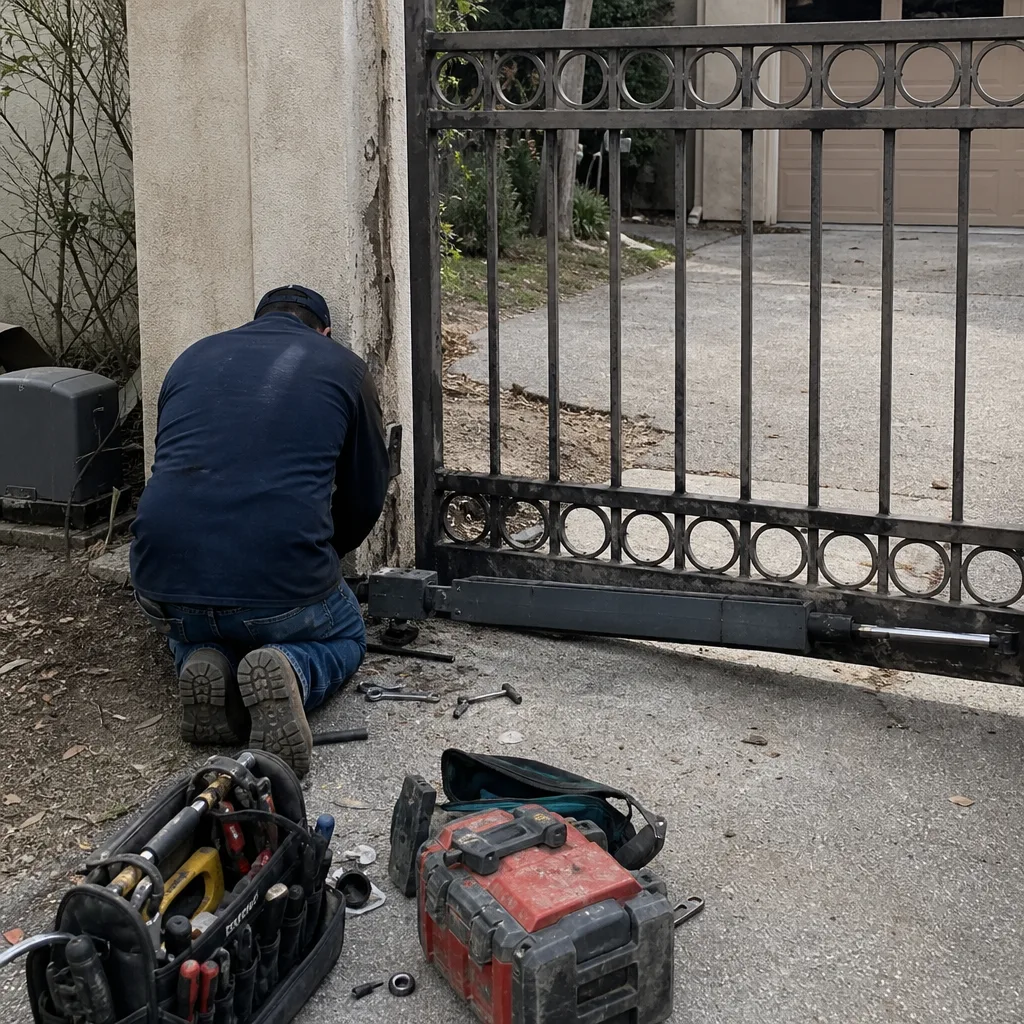 Before
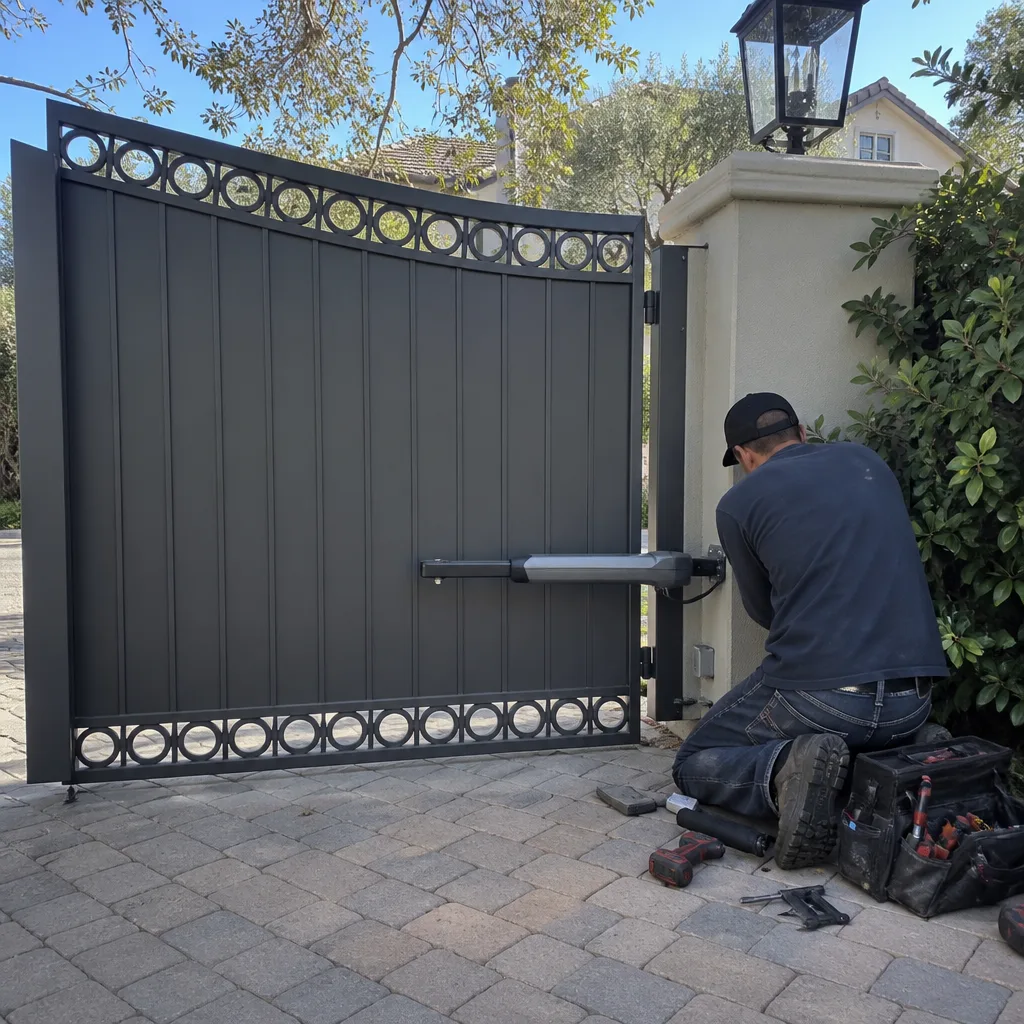 After
After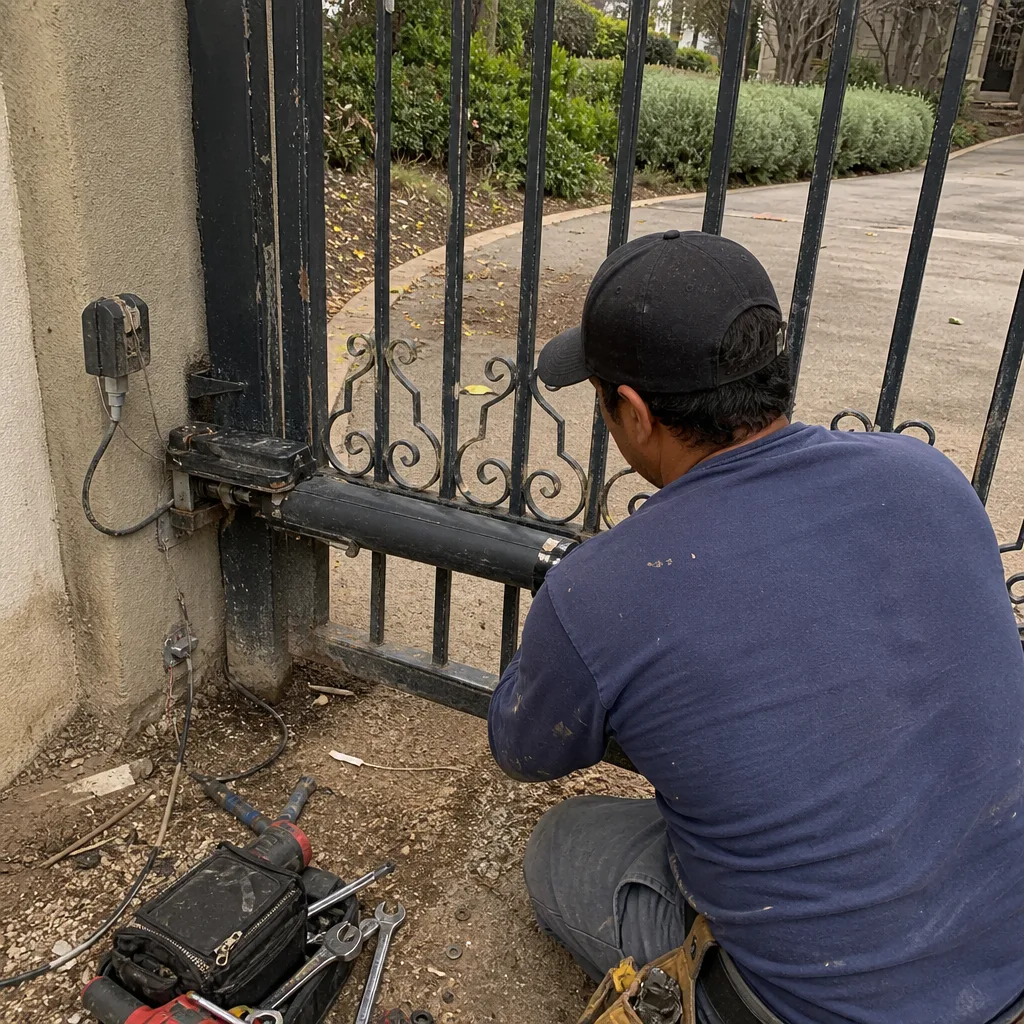 Before
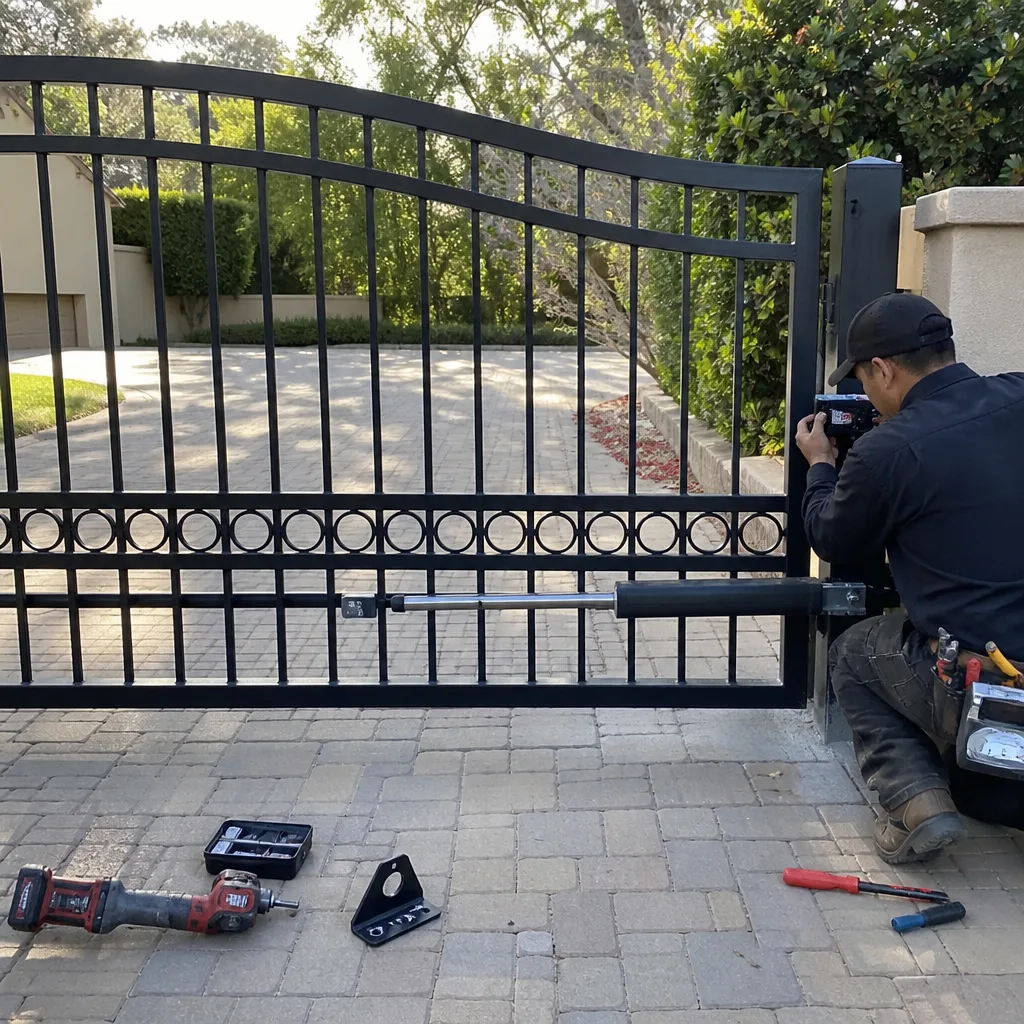 After
AfterThe Complete Guide to Gate Repair in Calabasas
Most driveway gates in Calabasas don’t fail because they’re old. They fail because they were installed without an eye toward the specific conditions of this valley: clay soil that shifts with every wet winter, Santa Ana winds that punish anything with even slight lateral play, and decades of daily cycles that no residential opener was ever really spec’d for. A gate that has opened and closed ten times a day for twenty years has cycled over 70,000 times. That’s a lot of metal fatigue. This guide explains what actually goes wrong with gates in Calabasas, what repairs cost, what you can safely check yourself, and when you need a specialist. You’ll learn how to spot small problems before they become midnight emergencies, and why certain local factors make gate maintenance here different from most of Los Angeles County.
Quick Answer
Gate repair in Calabasas typically costs $180-$450 for common issues like misaligned sensors, worn hinges, or receiver problems, while full opener replacement runs $1,200-$3,500, and welding or structural repairs start around $250. Most non-structural repairs take under two hours. The smartest move is to catch a gate problem in its first week, because Calabasas’s clay soil and wind exposure turn small alignment issues into cracked welds and burned-out motors faster than most homeowners expect.
Table of Contents
- How Gates Fail in Calabasas: The Local Factors
- What Gate Repair Costs in Calabasas
- Types of Gates We Service
- Gate Motors and Openers: What You Need to Know
- Safety Systems: Photo Eyes, Edges, and Why They Matter
- What You Can Safely Check Yourself
- The $89 Tune-Up and Seasonal Maintenance
- Common Mistakes to Avoid
- When to Call a Professional
- Frequently Asked Questions
- The Bottom Line
How Gates Fail in Calabasas: The Local Factors
Every region has its own way of breaking gates. In coastal towns, salt air corrodes hinges. In the desert, heat kills circuit boards. In Calabasas, the two forces that do the most damage are soil and wind.
The soil under much of Calabasas is expansive clay. It swells when the winter rains arrive and shrinks through the dry summer. Over a decade, that cycle moves gate posts – sometimes only a quarter inch, sometimes enough to make a gate drag on the ground or refuse to latch. We’ve seen gates in the Oaks and along Old Topanga Canyon Road where the post had moved so far out of plumb that the gate weighed 30 percent heavier on the motor than it did at installation. That extra load is what burns out otherwise healthy openers.
Wind is the second factor. Santa Ana events push sustained gusts against a solid gate panel with real force. If a gate has any play at the hinge – a worn bushing, a slightly stretched hinge bolt – the wind works that play like a lever, and the movement concentrates at the weakest point. Usually that’s the hinge-to-post connection. Left alone, it becomes a cracked weld or an elongated bolt hole. Once the geometry of the gate changes, the motor strains, the safety edges misalign, and a cascade of smaller failures follows.
Heat plays a supporting role. Summer temperatures in Calabasas regularly reach the high 90s, and a black metal gate sitting in direct sun can reach 140 degrees on the surface. The control boards inside opener housings don’t love that. Heat accelerates electrolytic capacitor aging, which is why opener circuit boards in Calabasas tend to die in August and September, not in January.
What this means for a homeowner: a gate here needs a quick look twice a year, even when nothing is visibly wrong. The conditions are always working on it.
What Gate Repair Costs in Calabasas
Most gate repairs in Calabasas land between $180 and $450. That range covers the majority of service calls we run: sensor realignment, hinge lubrication or bushing replacement, receiver or keypad replacement, limit switch adjustment, and minor steel repairs. Bigger jobs – a full opener replacement, a gate that needs to be cut down and rehung, a post that has to be reset in concrete – run higher, and rightly so.
Here’s a straightforward breakdown of what you can expect on a typical repair invoice in this market:
- Service call and diagnostic: $90-$150 (often credited toward the repair if you proceed the same day)
- Photo eye alignment or replacement: $110-$220
- Receiver or keypad replacement: $150-$300
- Hinge bushing, bearing, or minor hinge repair: $120-$350
- Welding repair (cracked joint, broken picket): $250-$650 depending on location and access
- Opener motor replacement (parts and labor): $900-$1,800
- Full opener and control board replacement: $1,200-$3,500 depending on brand and gate weight
- Post reset in new concrete: $700-$1,800 depending on depth, size, and finish work
Every price we quote gets agreed upon in writing before work begins. Not an estimate range, not “well, it depends on what we find” – a fixed number, settled before the first bolt is turned. That’s the only honest way to quote gate repair in a city where the underlying cause is often invisible until the gate is open and the panel is pulled.
For repairs over $250, Ironworks Gate Co. currently takes $50 off the invoice. Seniors and veterans get 5 percent off, always. And if you already have a written estimate from another company, we’ll give you a free second opinion on it. There’s a reason for this: the Calabasas market has a wide spread between reputable shops and one-truck generalists who price a job hoping you won’t ask what’s included. A written price is the only price that matters.
Types of Gates We Service
The driveway gate at the top of a Calabasas hill has very little in common, mechanically speaking, with the pedestrian gate at the side of a townhouse near the Commons. Different gates fail differently, and the repair approach has to match the design.
Swing Gates
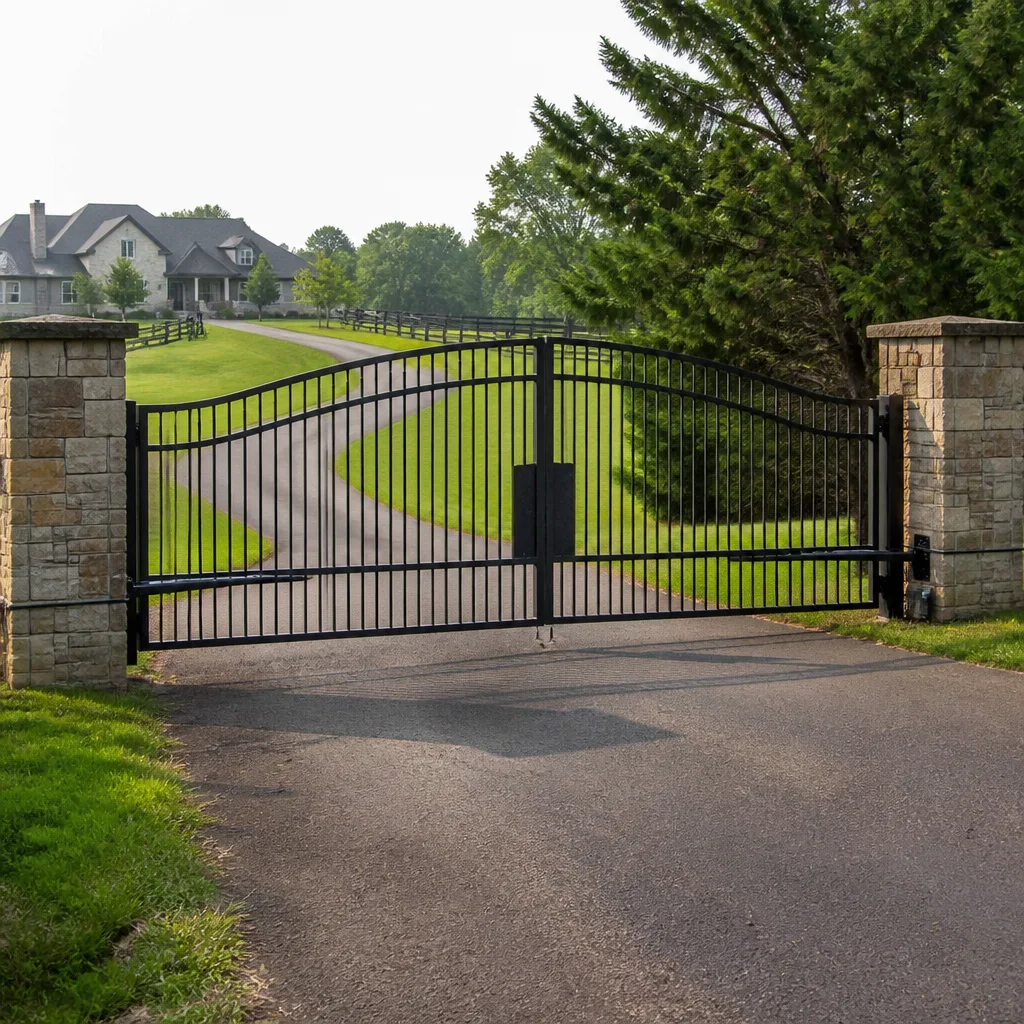
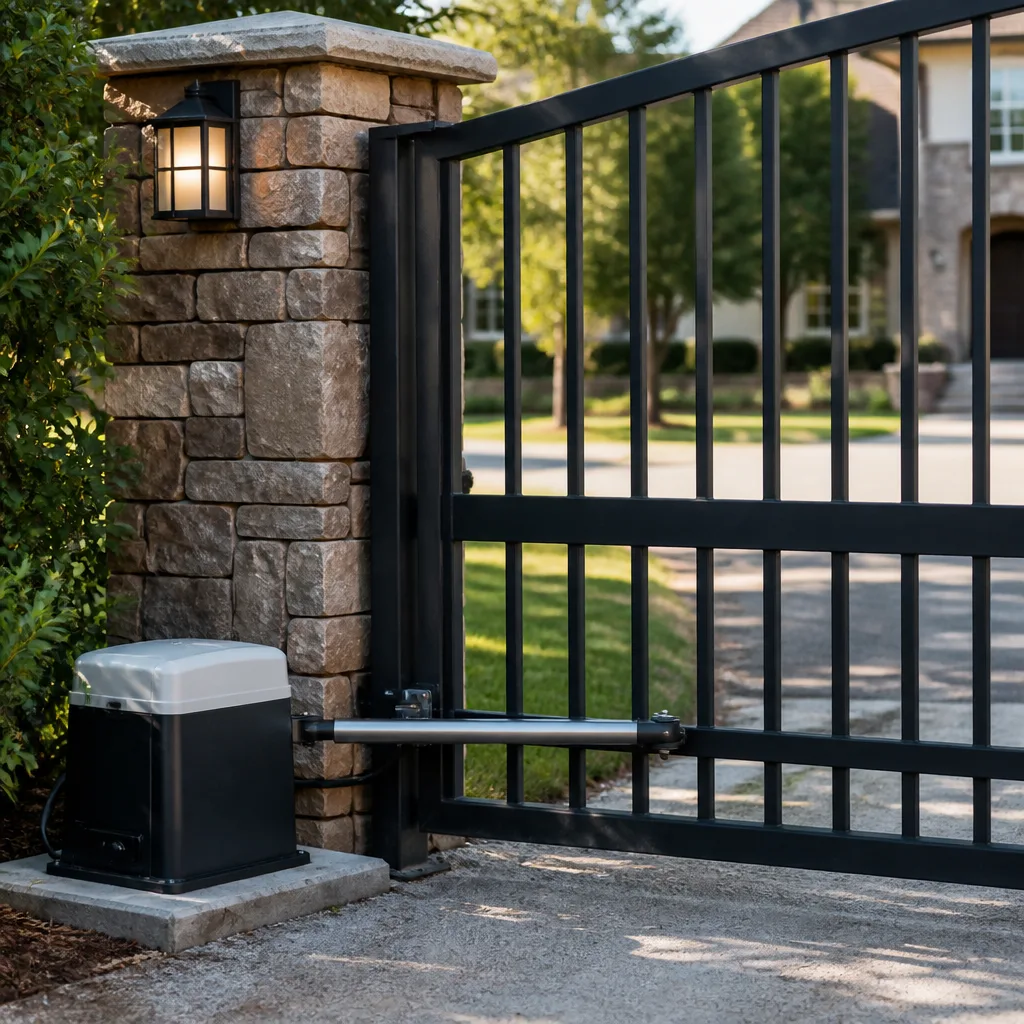
The classic Calabasas driveway gate. A single leaf or a pair of leaves swing on hinges mounted to posts or stone columns. These are the most common style in Calabasas Park, Mulholland Heights, and the gated communities off Las Virgenes Road. Swing gates that have been in service ten years or longer typically need hinge work: bushing replacement, bolt replacement, or grease and adjustment. The motors that drive them are either linear arm openers mounted on the post or underground openers built into the hinge line. Both are serviceable. Underground openers cost more to repair because of the excavation involved, but they’re the cleanest look for a high-end entry.
Sliding Gates
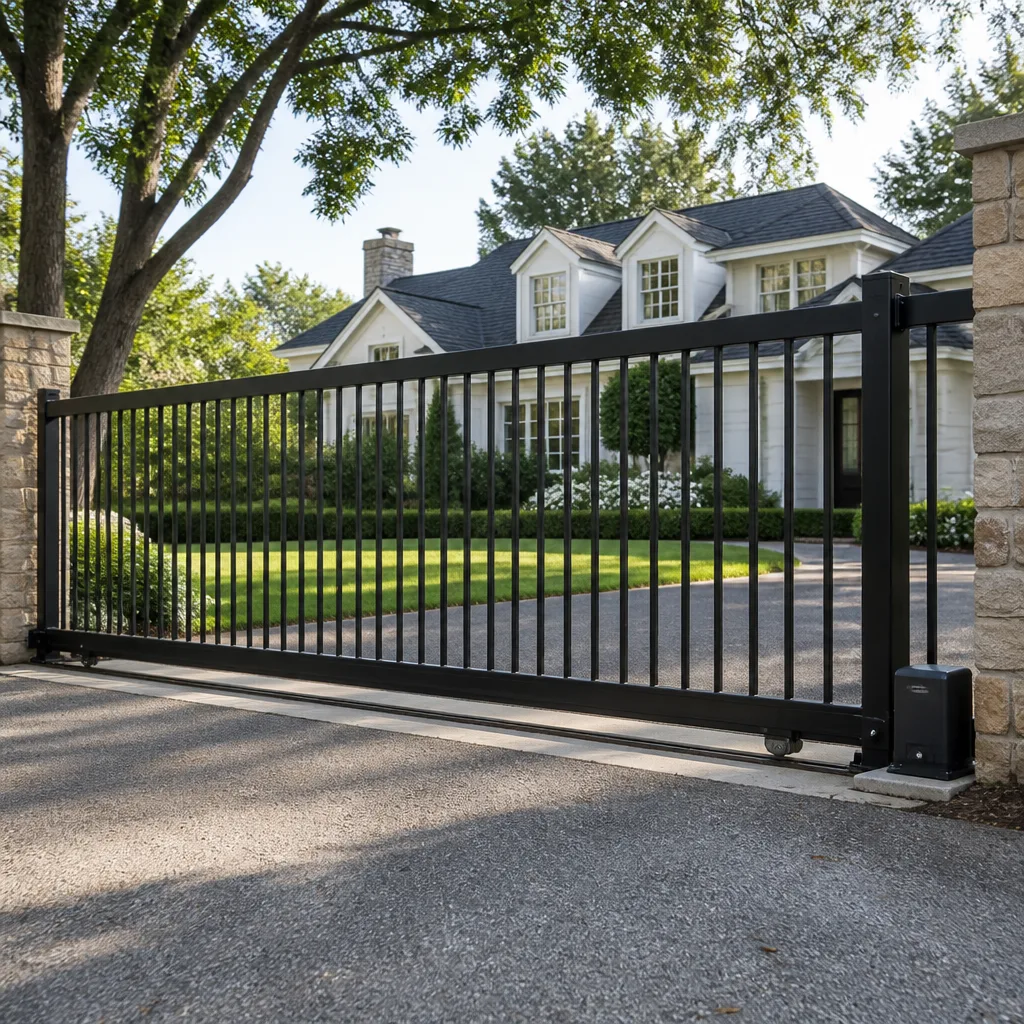
Less common in Calabasas residential driveways simply because of lot geometry, but you see them on longer estate parcels where the driveway runs parallel to the house. Sliding gates wear on the rolling track and the guide wheels. When a sliding gate starts to groan or jump, that’s usually a flat-spotted wheel or debris in the track. The repair is straightforward, but you want it done before the wheel wears through, because a gate that derails can damage the top guide and bend the panel.
Pedestrian Gates
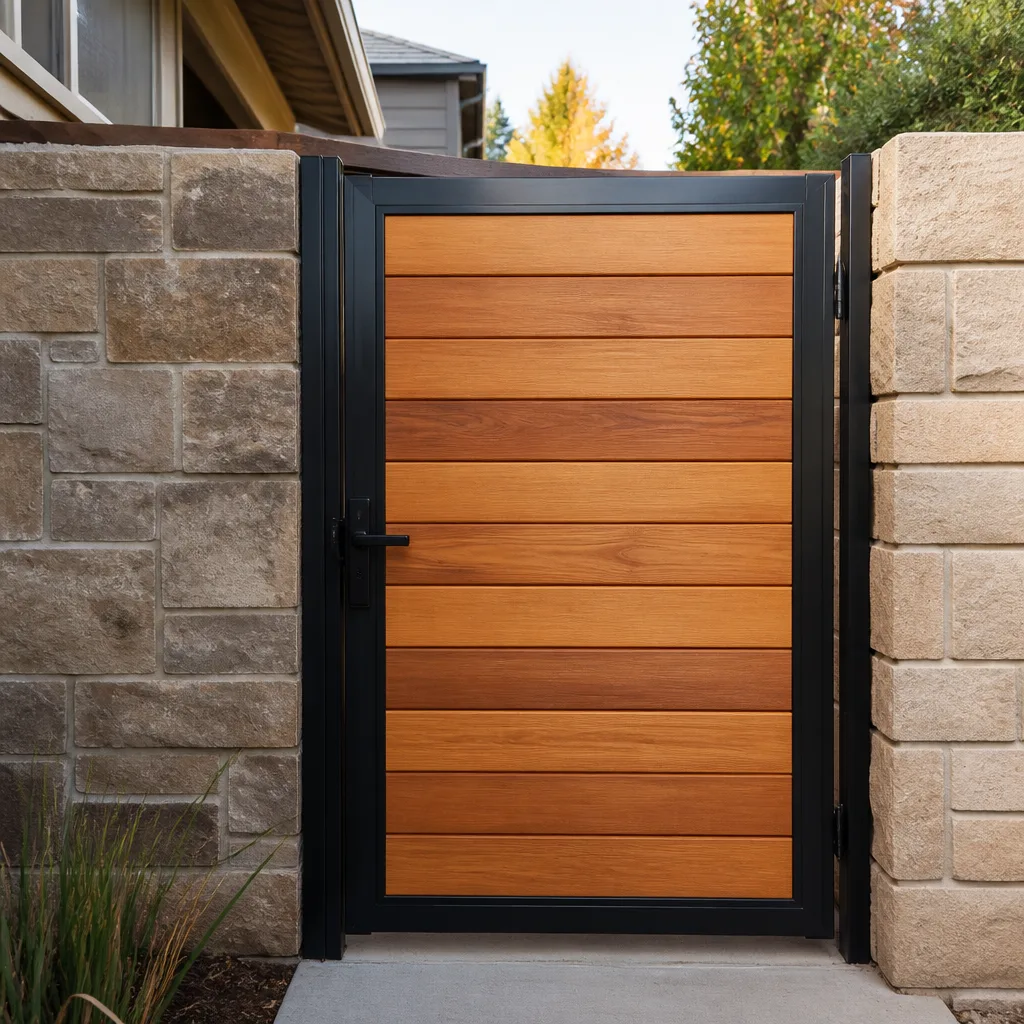
Side-yard and garden gates do their own thing. They’re smaller, lighter, and frequently ignored until the latch no longer catches or the hinges have sagged enough to drag the concrete. The fix is usually fast. But if the pedestrian gate has its own intercom or access control tied to the main system, the wiring and controls add a layer of complexity.
Whatever the style, the same rule applies in Calabasas: the gate has been settling and shifting since the day it was poured. At Ironworks Gate Co., we handle the full range of driveway and estate gate services – repair, installation, motors and openers, access control, and parts and welding – and we see the same failure patterns repeat across every style: soil movement, wind-driven wear, and deferred maintenance.
Gate Motors and Openers: What You Need to Know
The gate opener is the heart of the system, and it’s the part that Calabasas homeowners most often misunderstand. A residential gate opener is a motor, a gearbox, a control board, and a set of safety and access peripherals. It is not a garage door opener bolted to a gate. It operates outdoors, in the heat, under load, year after year. When it fails, the question is rarely “do we fix it” but “is this motor worth rebuilding, or are we past the point of sensible repair?”
Here’s the honest math. A quality residential swing gate opener costs $900 to $1,800 installed. If your existing opener is 15 years old, has burnt contacts, a failing gearbox, and a board that has already been replaced once, you’re looking at spending 60 percent of a new opener on a repair that buys you another two or three years. Sometimes that’s the right call. Sometimes it isn’t. You should be given both options and let the numbers speak.
Brand matters because the repair process differs. We carry programming and diagnostic capability for LiftMaster, FAAC, BFT, Linear, Viking, Ghost Controls, DoorKing, Elite, and Mighty Mule, and we’ve made thousands of first-visit repairs across those brands. That matters more than most companies will admit. A technician who says “all openers are the same” is the technician who shows up, guesses, and leaves you with a gate that works for two weeks and then quits on a Sunday night. An Elite opener does not fail like a Mighty Mule opener does. A DoorKing board does not diagnose like a LiftMaster board. If the technician has to order parts and come back, that’s another service call, another gap in your security, and another invoice.
In Calabasas, openers also face a specific local challenge: power quality. The same Santa Ana winds that push on your gate also take down power lines. A gate opener that suffers repeated brownouts or voltage sags will eventually lose its control board. If your gate has been on the original board for more than eight years and you live up one of the canyon roads where the power flickers regularly, a surge protector or a small battery backup is cheap insurance.
Safety Systems: Photo Eyes, Edges, and Why They Matter
Every automatic gate in California is required to have two things that a casual observer rarely notices: photo eyes and a reversing mechanism. The photo eyes are the small paired sensors near the base of the gate opening, one on each side, and they exist to stop the gate if something crosses the path. The reversing mechanism – usually monitored through the control board and often backed by a physical safety edge strip on the leading edge of the gate – exists to reverse direction if the gate contacts an obstacle.
Here’s what Calabasas homeowners should understand about these systems: they fail silently. The gate keeps opening and closing. The photo eyes fall out of alignment – a post shifts a quarter inch in the clay, and suddenly the beam misses. The safety edge cracks with age, and the internal circuit never sends the signal. The gate works right up until the moment it doesn’t reverse. Then you have a several-hundred-pound panel that will not stop for a car, a dog, or a grandchild.
This is a genuinely dangerous component of a gate system. When a gate is out of adjustment and does not reverse on contact, it can cause serious injury. Testing and repairing safety systems is not a do-it-yourself project. A trained technician tests the reversal force with a proper gauge, verifies the photo eye alignment under different light conditions, and confirms the edge sensor circuit end to end. We treat every safety-system repair as a priority, because a gate that closes reliably but does not reverse safely is the most dangerous thing on the property.
What You Can Safely Check Yourself
You don’t need to be a gate technician to catch the early signs of trouble. There are five checks any Calabasas homeowner can do in ten minutes, without tools and without risk. Do these twice a year, once in the spring and once after the first Santa Ana season in the fall.
- Look at the gate in the closed position. Stand in front of it and sight along the top edge. A gate that is leaning even slightly has a hinge or post issue forming. The top of the leaf should sit parallel to the top of the post or column.
- Run the gate manually, if your opener has a manual release. A properly hung gate should push freely by hand from the midpoint of its travel, without binding or dragging. If it feels heavy or stiff, the motor is working harder than it should.
Important: If you have an opener, even a small amount of binding puts strain on the gearbox and the board. Do not attempt to adjust the hinges or posts yourself. This is steel under load, and hinge work on an automatic gate should be left to a professional.
- Listen for new sounds. A gate that used to run quietly and now squeaks, groans, or clunks is telling you something has changed. A high squeak is usually a hinge. A low groan is usually the opener gearbox. A grinding sound from a sliding gate is the track. Write it down and watch it. If it gets worse over two weeks, call.
- Check the photo eyes. With the gate moving, pass your hand through the beam near the base of the opening. The gate should stop or reverse. Do not test the reversing mechanism by putting your body in the gate’s path. The hand test on the photo eyes is safe. Testing whether a closing gate will reverse on contact is a technician’s job with a force gauge.
- Check the gate’s rest position over the weeks. Take a photo of the gate fully closed. Two months later, take another from the same angle. If the shadow line under the gate has changed, the post is moving. In Calabasas, this is the earliest and least obvious sign of clay-soil movement.
None of these checks fixes anything, and that’s the point. They give you early warning. If any check turns up something off, call a gate specialist. The cost of a diagnostic visit is small compared to the cost of tearing down and re-hanging a gate that has pulled itself apart.
The $89 Tune-Up and Seasonal Maintenance
The single best-dollar-for-dollar investment in a gate system is an annual tune-up, done before the winter rains and after the worst of the summer heat. In Calabasas, the right season is September or October, right before the rainy months start and the clay begins to expand.
A proper seasonal tune-up includes:
- Hinge inspection and greasing: every hinge, bushing, and bearing looked at, moved, and lubricated
- Photo eye realignment: the beam checked, adjusted, and verified
- Safety edge circuit check: the reversing mechanism tested and measured
- Control board inspection: burned or swollen capacitors, loose terminal connections, heat damage
- Opener oil check: the gearbox fluid, where applicable, topped or changed
- Track and wheel cleaning: for sliding gates, the full length of the track inspected
- Fastener check: every accessible bolt, nut, and lag checked for torque
- Full cycle test: a dozen open-close cycles with measurements on load and travel
Ironworks Gate Co. runs the seasonal tune-up at $89, and for that price we treat it the same way we treat a welding job: a craft task done by a real person who is paying attention. The tune-up is not a “20-point inspection” that takes eight minutes and ends with a pamphlet. It’s the difference between catching a hinge bushing at $120 and catching a bent post and a burned motor at $2,500.
Common Mistakes to Avoid
- Ignoring a gate that opens slower than it used to. A slower gate means more electrical load and more heat. The motor is working harder because something is dragging. Letting it drag for a year guarantees a shorter opener lifespan.
- Using WD-40 or penetrating oil on gate hinges. WD-40 is a water displacer, not a lubricant. It actually strips the heavy grease that gate hinge pins need and leaves the metal more vulnerable to the dust and grit that Santa Ana winds carry. Proper gate hinge grease is thick, water-resistant, and made for slow-speed, high-load pivots.
- Testing the auto-reverse by standing in the gate’s path. The correct test uses a force gauge, not a body. A teenager or a house guest standing in the way of a closing gate to “see if it stops” is risking serious injury. The photo eye hand test is the only self-test anyone should perform.
- Letting a handyman or fence company rebuild a gate motor. Fence companies build fences. Gate automation is an electrical and control-systems trade layered on top of steel work. A welded repair that ignores motor load, safety circuits, and travel limits is how gates get ruined and people get hurt.
- Building a taller or heavier gate on an existing opener. Homeowners in Calabasas sometimes replace a gate panel with something heavier – a solid iron design, a wood-fill panel – without re-spec’ing the opener. A motor that was marginal on the old gate becomes overloaded on the new one and dies within a year or two.
- Delaying a post repair. A post that has moved a quarter inch will move another quarter inch the following year. The longer it runs, the more damage the geometry does to the hinges, the motor, and the gate itself. A post reset is not the repair anyone wants, but it’s the one that prevents three other repairs.
- Programming a new remote without clearing old codes. When a remote is lost or a house changes hands, the existing access codes remain in the receiver. Erasing and reprogramming access codes is a basic security step that most homeowners in Calabasas never do after buying a house with an automatic gate. You don’t know how many remotes and keypads are still enrolled.
When to Call a Professional
Call a gate professional when the gate moves differently than it did a month ago – slower, noisier, chattering, or stopping mid-travel. Call when the photo eye beam will not hold alignment despite your adjusting it. Call when a hinge pin or bolt shows visible play. Call when the opener tripped a breaker or stopped responding to remotes and keypads. Call when the gate reverses without something in its path. And call immediately, any hour, if the gate is stuck open and the house has no barrier – a live person answers our phone 24 hours a day, 7 days a week. These are not problems you wait on. A gate that fails closed is an inconvenience. A gate that fails open or fails to reverse is a safety and security problem. Ironworks Gate Co. offers free estimates in Calabasas – call (747) 308-3262 and we’ll put someone on it.
Frequently Asked Questions
Most gate repairs in Calabasas cost between $180 and $450, with big jobs like opener replacement running $1,200 to $3,500 and welding repairs starting around $250. The final price depends on gate size, opener brand, and how long the problem has been running. Ironworks Gate Co. quotes a fixed price before work starts, and repairs over $250 currently get $50 off. Call (747) 308-3262 for an exact quote on your gate – estimates are free.
Yes. Ironworks Gate Co. runs same-day and emergency gate repair service in Calabasas, and a live person answers the phone 24 hours a day, 7 days a week. If your gate is stuck open or stuck closed and the house is unprotected, call (747) 308-3262 and we’ll dispatch a technician as soon as one is available. Most non-structural repairs are completed in a single visit.
We service and repair nine major gate automation brands: LiftMaster, FAAC, BFT, Linear, Viking, Ghost Controls, DoorKing, Elite, and Mighty Mule. Technicians arrive with the programming equipment and diagnostic tools for all of these, which means the correct repair is usually made on the first visit. If you have a different brand, call (747) 308-3262 and we’ll tell you straight whether we can work on it.
A quality residential gate opener in Calabasas typically lasts 10 to 15 years with regular maintenance, though canyon properties with frequent power quality issues or heavy wind exposure tend to run shorter. The two things that shorten opener life here are heat-related board failures and overloading from a gate that has drifted out of alignment. A $89 seasonal tune-up catches those conditions early.
Yes. A full gate installation includes the structural work, the opener, the power run, and the complete safety system – photo eyes, safety edges, and reversing verification. We do not install gates without the safety systems functioning to code, no exceptions. For a new gate in Calabasas, we provide a free measure and a written price before any work starts. Call (747) 308-3262 to schedule the measure.
No. Increasing noise in a gate system is a mechanical symptom that will not improve on its own. In Calabasas, where wind and clay soil are constantly working the gate’s geometry, noise usually means a hinge bushing or opener gearbox is wearing toward failure. Repairing a worn bushing is a $200 job; replacing an opener that burned out from the extra load is a $1,500 job. Call (747) 308-3262 and we’ll diagnose the noise, the price is quoted before work begins.
The Bottom Line
Calabasas is hard on gates. The clay soil moves the posts, the wind works the hinges, the heat cooks the control boards, and by the time a gate fails completely it has usually been warning you for months. The fixes that cost the least are the ones you catch early: a hinge bushing, a misaligned photo eye, a dragging track. The fixes that cost the most are the ones deferred: a bent post, a burned motor, a gate re-hang. If you do one thing this year, do the $89 tune-up in September. If your gate is already misbehaving, call a specialist who services all nine major opener brands, quotes a fixed price, and stands behind the work in writing. The company that makes a 40-year-old gate close like the day it was hung is the company you want on speed dial.
Written by Victor Salinas, Owner at Ironworks Gate Co., serving Calabasas since 2013.