
Last updated August 25, 2026
Free on-site gate assessment - hinges, posts, and your LiftMaster or Nice gate operator checked before anything is quoted
The assessment is free and the quote is the invoice.

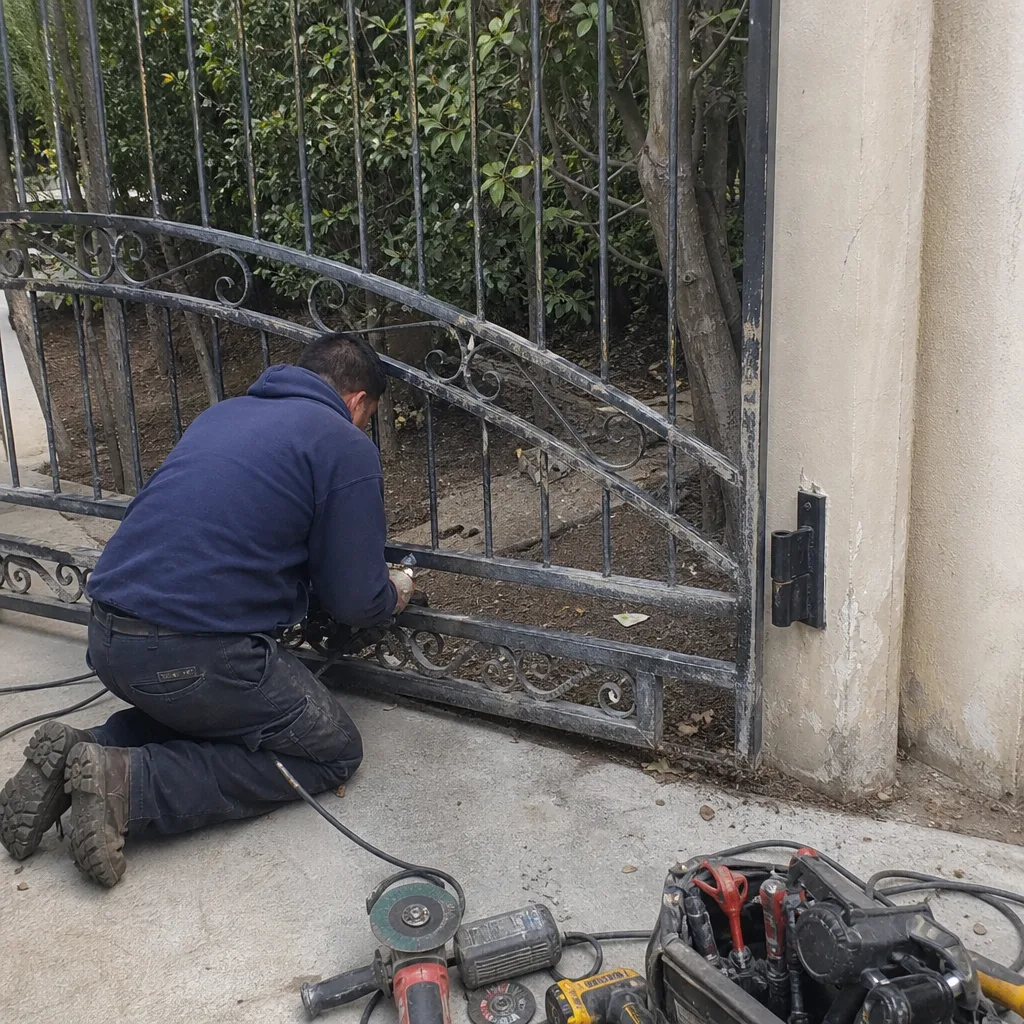 Before
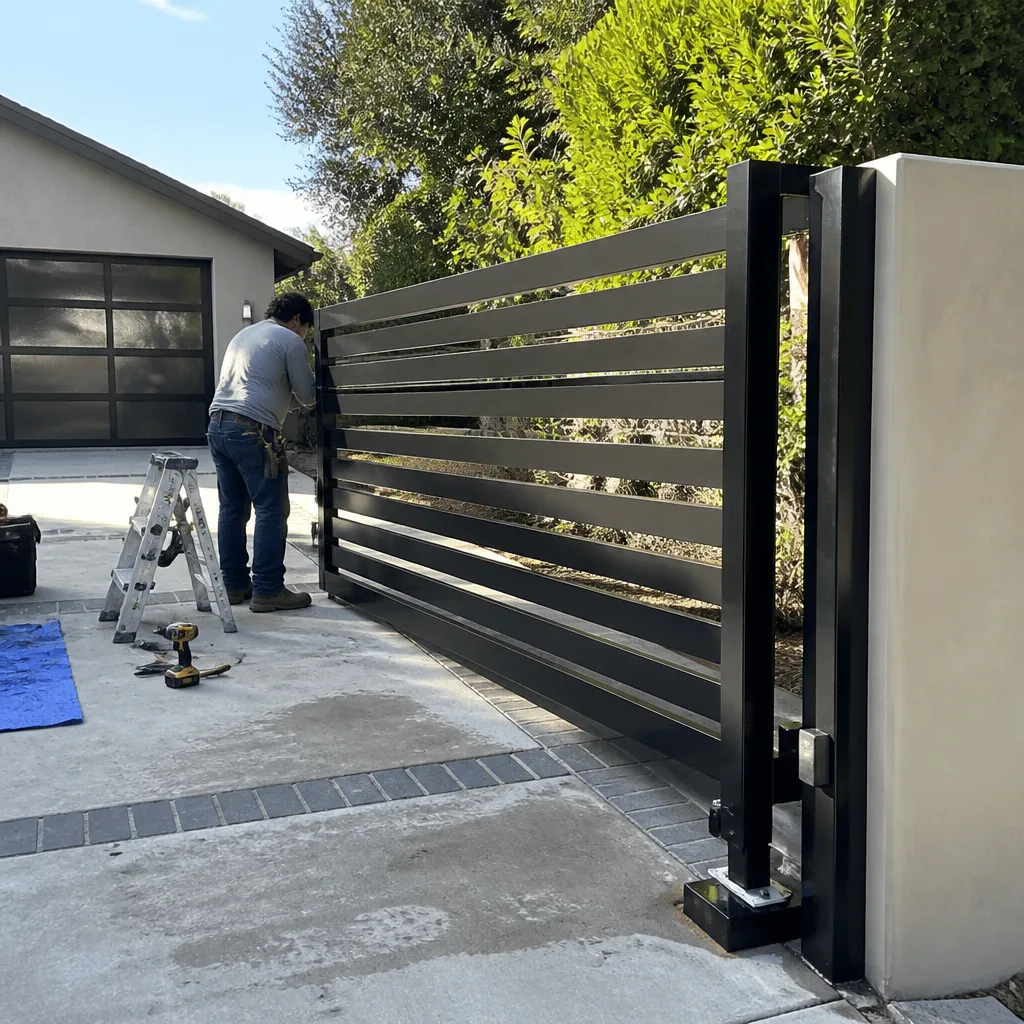 After
After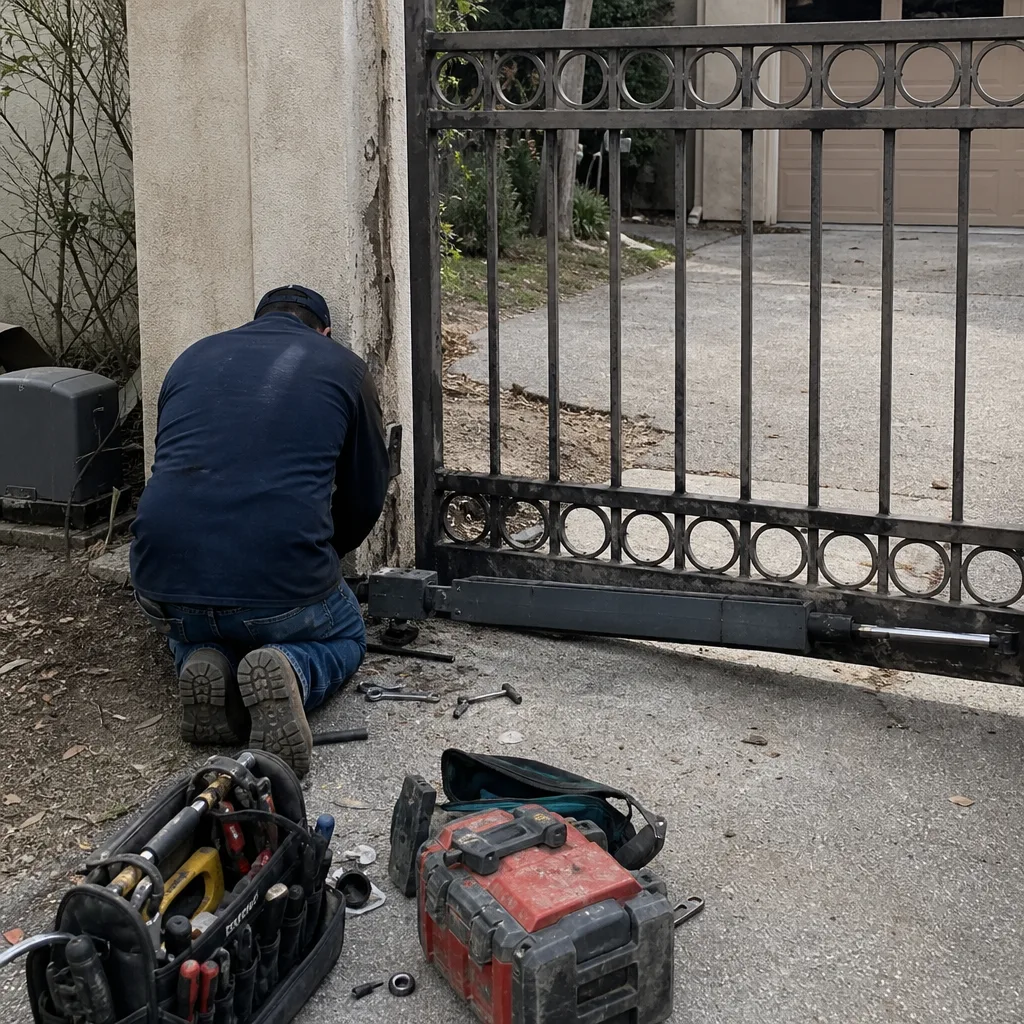 Before
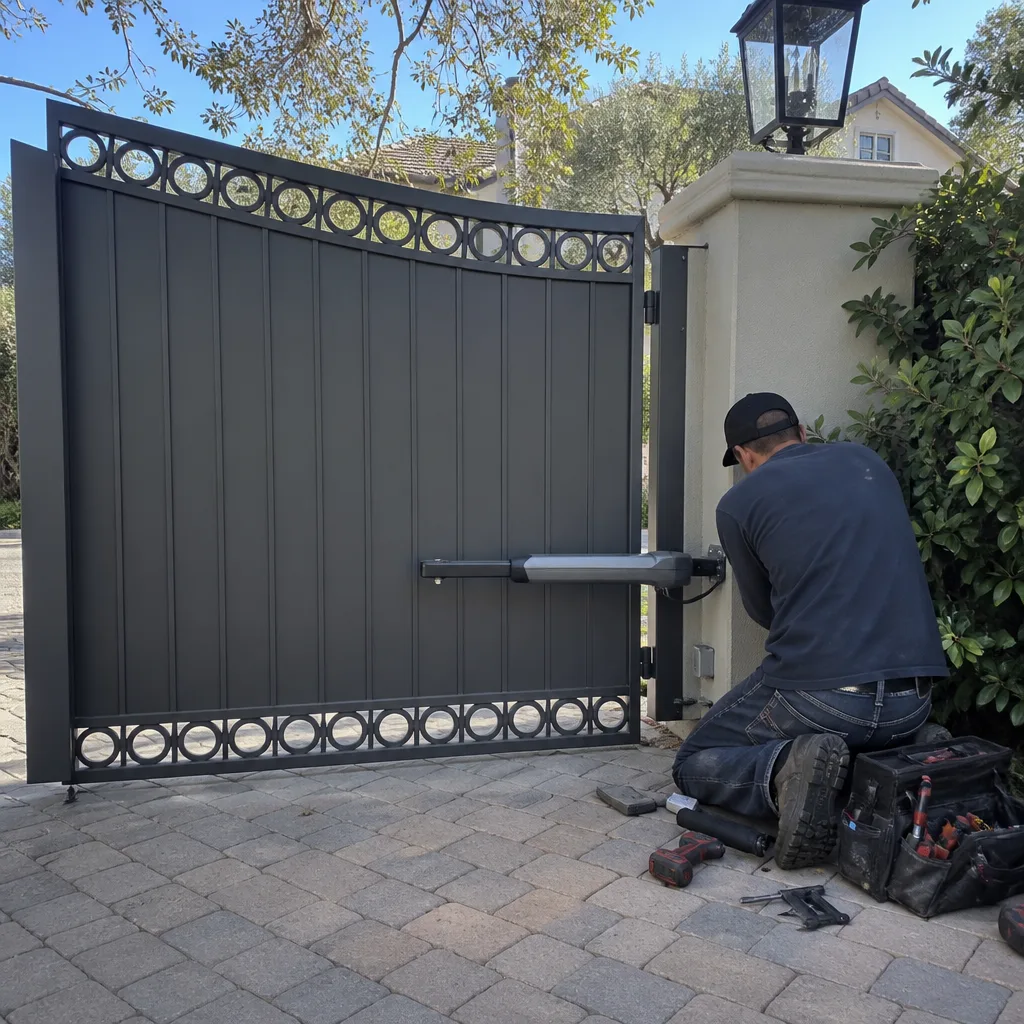 After
After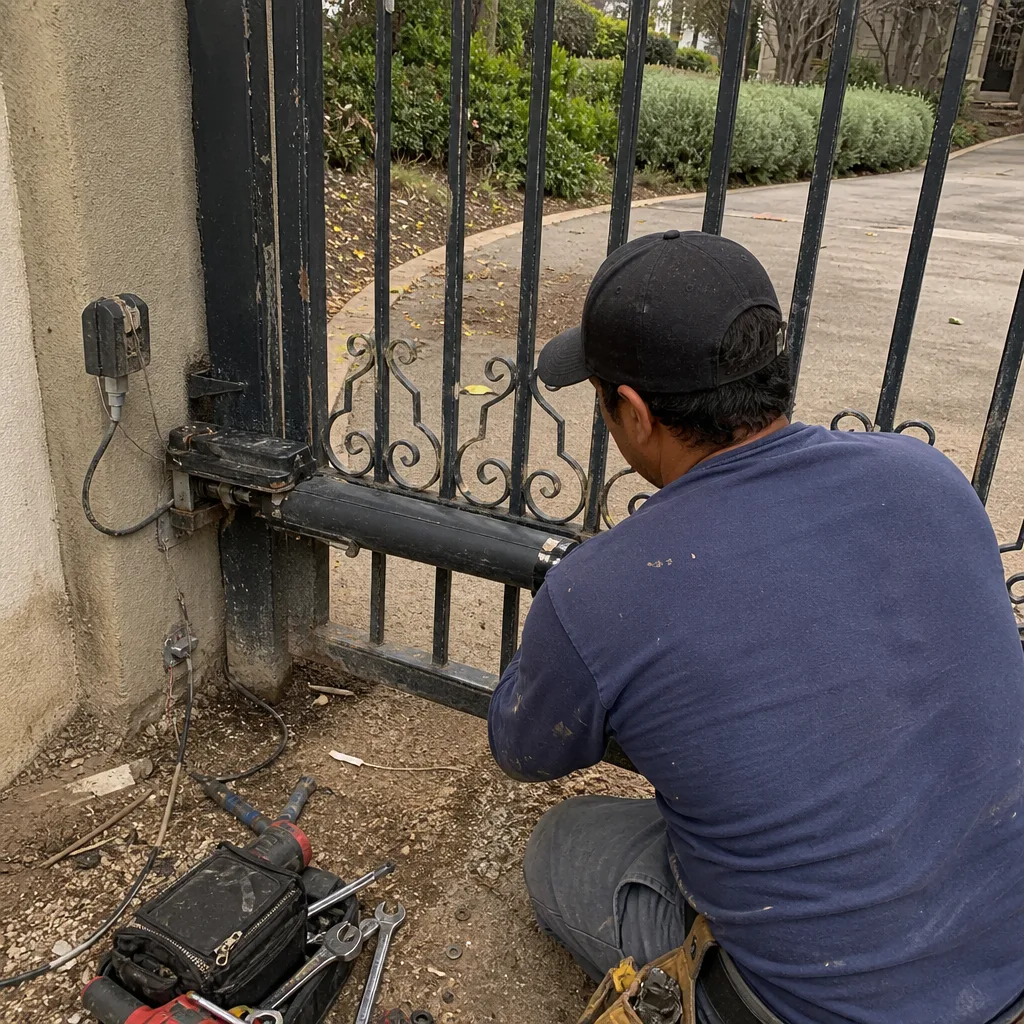 Before
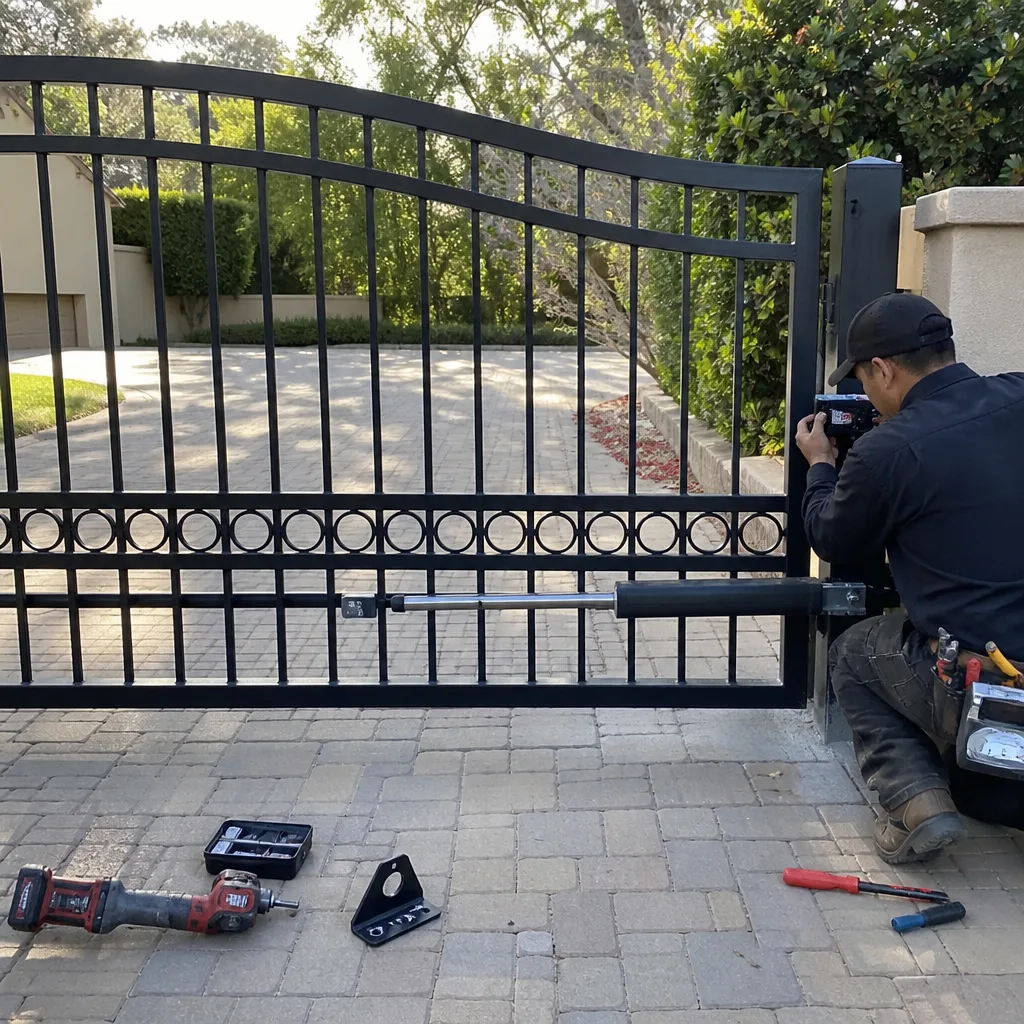 After
AfterGate Repair Warning Signs: A Calabasas Homeowner’s Reference Guide
Most gate failures in Calabasas don’t happen suddenly. They announce themselves weeks, sometimes months, in advance, through small changes in sound, speed, and movement that most homeowners write off as the gate simply showing its age. Then the gate stops mid-cycle on a Thursday morning with a car trapped in the driveway. This guide walks you through the warning signs we’ve documented across thousands of service calls in Calabasas and the surrounding canyon communities, what each symptom typically means, what it costs to address it early versus late, and when the right move is a phone call rather than another month of hoping the noise goes away.
Quick Answer
The earliest warning signs of gate trouble are a change in sound (grinding, humming without movement, clicking), a change in speed (slower starts, stuttering mid-travel, slamming at the end), and visible sagging at the hinge side. In Calabasas, wind-driven dust from the Santa Monica Mountains accelerates track and roller wear, so gates here often show symptoms earlier than coastal properties. Any of these signs means the gate is working harder than it should, and the repair is almost always less expensive the day you notice it than the day it fails completely.
Table of Contents
- Sound Warning Signs: What Your Gate Is Telling You
- Movement Warning Signs: Speed, Hesitation, and Drift
- Visible Warning Signs: Sag, Rust, and Track Wear
- Automation Warning Signs: Opener Behavior That Spells Trouble
- What Causes Gate Failure in Calabasas Specifically
- Early Repair vs. Late Repair: What Each Path Costs
- What You Can Check Yourself vs. What Needs a Pro
- Common Mistakes to Avoid
- When to Call a Professional
- Frequently Asked Questions
- The Bottom Line
Sound Warning Signs: What Your Gate Is Telling You
A healthy gate makes a steady, even sound. The motor hums at a consistent pitch, the wheels roll without scraping, and the only real noise is the soft click of the limit switch when the gate reaches fully open or fully closed. When that sound changes, the gate is communicating something specific.
The Gate Grinds or Scrapes During Travel
Grinding almost always points to the load-bearing path: the wheels, the track, or the rollers carrying the gate’s weight. In Calabasas, where dry winds push fine dust and grit into every seam, track contamination is the single most common cause we see. That grit acts like sandpaper. Every cycle grinds it deeper into the bearing surfaces. If the sound has a rhythmic quality, scraping once per wheel revolution, you likely have a flat-spotted or seized wheel. If it’s a continuous metallic drag, the gate may have dropped slightly and is now dragging its own frame across the track. Either way, the fix is straightforward when caught early: clean the track, inspect and replace worn wheels, and re-level the gate. Left alone, a dragging gate forces the motor to work against constant friction, which burns out opener capacitors and gearboxes far faster than normal use.
The Gate Hums But Does Not Move
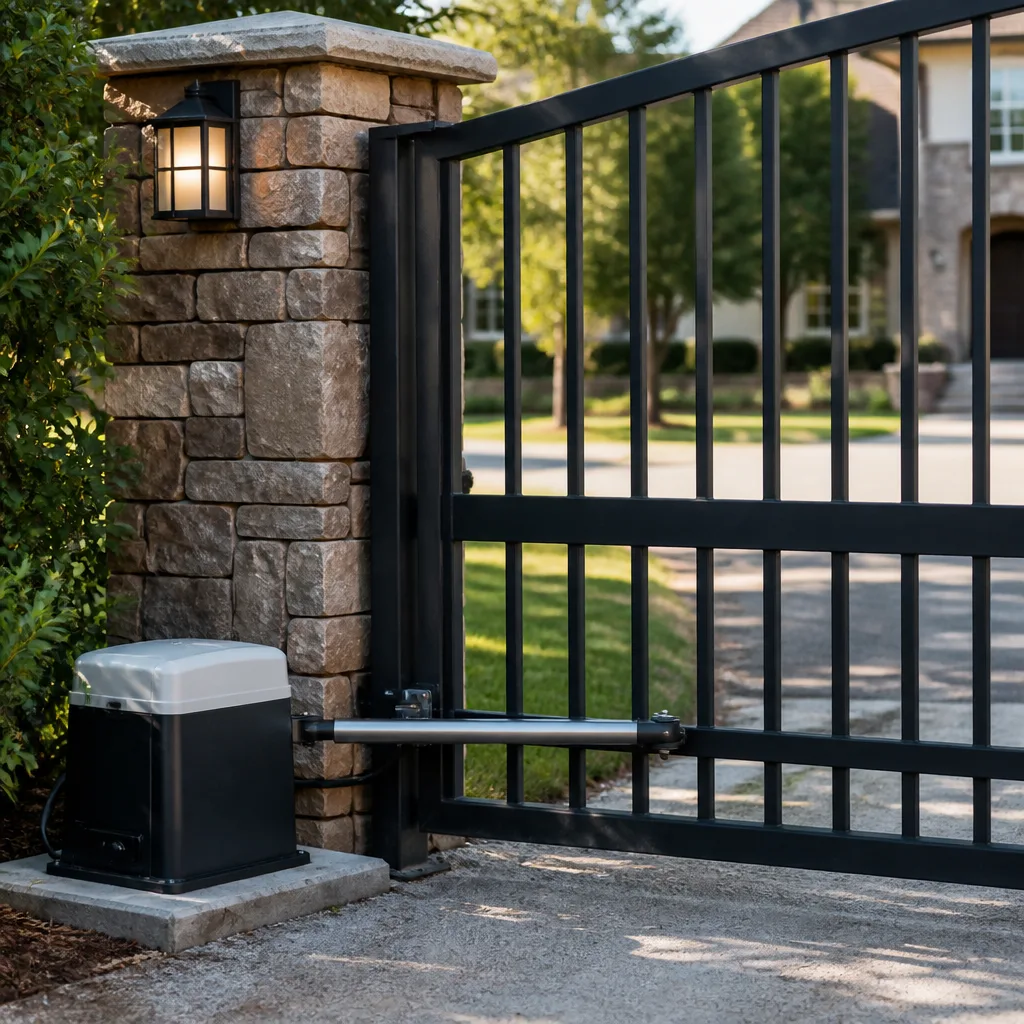
This is the classic capacitor failure on gate openers, and it’s one of the calls we take most often in Calabasas. The capacitor is the electrical component that gives the motor its starting jolt. When it fails, the motor tries to start, can’t, and sits there humming until the thermal overload shuts it down. On brands like LiftMaster and DoorKing, a humming motor with no movement is the textbook capacitor symptom. The good news: capacitors are inexpensive, readily available, and replaceable in a single visit. The bad news: every time you let the gate sit there and hum, you’re heating the motor windings and shortening the life of a much more expensive component. If you hear a hum, kill power to the opener at the breaker and call for service. The part is cheap. The motor it protects is not.
Clicking Sounds From the Opener
A rapid clicking at the control board usually means the relay is firing but the motor isn’t responding, which points to a failed motor capacitor, a bad connection, or a board-level fault. A single solid click followed by nothing often indicates a seized gearbox or a gate that’s physically jammed against an obstruction. On Mighty Mule and Ghost Controls units, which use different drive mechanisms than the big commercial operators, clicking can also indicate a limit-switch problem where the board thinks the gate is already in position. The diagnostic difference matters because the fix ranges from a five-minute limit-switch adjustment to a full gearbox replacement, and mistaking one for the other wastes time and money.
Movement Warning Signs: Speed, Hesitation, and Drift
Movement changes are the warnings homeowners most often dismiss. A gate that starts a fraction slower than it used to, or hesitates for half a second after the remote is pressed, doesn’t feel like an emergency. But movement is the single best diagnostic signal a gate gives you, because every change in movement corresponds to a specific mechanical or electrical condition.
The Gate Starts Slowly Then Jerks Into Motion
This is almost always a lubrication or alignment issue, not a motor problem. The gate sits at rest, the motor starts, and the gate resists that first movement because something is binding: a dry hinge, a wheel that has settled into a worn flat spot, or a track that has shifted slightly out of alignment. Once the motor overcomes that initial resistance, the gate jumps forward. In Calabasas, where summer temperatures routinely exceed 95 degrees and winter nights drop into the 40s, gates cycle through meaningful thermal expansion and contraction every year. Metal grows and shrinks. Bolts that were tight in November are loose by August. That yearly movement is why a gate that worked perfectly for years can suddenly start to bind at one specific point in its travel. The fix is typically a realignment and lubrication service, the kind of thing that takes an experienced tech under an hour.
The Gate Stutters or Pauses Mid-Travel
Stuttering mid-travel, where the gate moves, stops, moves, stops, in a jerky rhythm, points to an intermittent electrical connection. The most common culprits are worn motor brushes, a failing control board relay, or a corroded connection somewhere in the low-voltage wiring. Calabasas properties near the canyons deal with higher humidity in the morning hours than the open valley floor, and that moisture finds its way into any unsealed connection. The behavior is dangerous to ignore because an intermittent connection doesn’t just make the gate jerky, it can cause the gate to reverse unexpectedly or stop in a partially open position that looks closed from the house but leaves the property unsecured.
The Gate Slams at the End of Its Travel
A gate that starts smoothly but then slams hard against the end stop has lost its deceleration control. On hydraulic operators, this usually means the pressure relief valve has drifted or the hydraulic fluid is low. On belt- or chain-drive operators, it often means the limit switches are misadjusted or failing, so the opener doesn’t know where the end of travel is until it hits it. Beyond the jarring noise, a slamming gate is putting impact stress through every weld, every hinge, every bolt on the gate leaf. That repeated impact is how gates start to crack at stress points. Calabasas homes with heavier iron gates, the kind that weigh 600 pounds or more, feel this effect faster than lighter aluminum gates. The damage accumulates silently until the day a weld lets go.
The Gate Reverses Mid-Cycle for No Apparent Reason
Safety-edge reversal is designed to protect people and vehicles, so when a gate reverses without anything in its path, the safety system is giving a false positive. This typically means the safety edge sensor strip is wearing out, the photo-eye alignment has drifted, or the loop detector under the driveway is picking up interference. It’s a relatively minor fix when addressed promptly, but every false reversal adds wear cycles to the opener and confuses the limit-logic on the control board. On Elite and LiftMaster operators, we’ve seen repeated false reversals eventually corrupt the open/close position memory, which then requires a full re-learn procedure rather than a simple sensor replacement.
Visible Warning Signs: Sag, Rust, and Track Wear
Some of the most important warning signs don’t require listening or watching the gate move at all. They’re visible the moment you walk outside. And in our experience, these are the signs Calabasas homeowners notice first but act on last, because they seem cosmetic rather than structural.
The Gate Sags on the Hinge Side
A sagging gate is the most serious visible warning sign a homeowner can ignore. When a gate leaf drops on the hinge side, it means the hinge bearings, the hinge pins, or the post itself is failing. Every cycle the gate makes while sagging multiplies the damage. The gate’s weight, which was designed to transfer straight down through properly aligned hinges, is now pulling sideways on those hinge points. Within weeks of the first visible sag, the hinge barrels begin to oval out. Within months, the welds at the post can start to crack. We’ve seen gates in Calabasas that sagged for a year before the hinge finally tore free, and by that point the repair required re-welding the gate frame, reinforcing the post, and replacing every hinge on that leaf, a job that runs several times what a hinge replacement would have cost at the first sign of sag. The rule is simple: if the gate doesn’t sit level, the clock is already running.
Rust Bubbles at Weld Points and Hardware
Calabasas doesn’t have the salt-air corrosion problems of beach communities, but it does have morning marine layer moisture, dry daytime heat, and the occasional Santa Ana wind carrying abrasive dust. Powder-coated gates resist this environment well, but any scratch, chip, or factory weld point is a potential rust entry point. Surface rust is cosmetic. But rust bubbles at weld joints and around hinge bolts indicate corrosion working into the metal itself. Once a weld starts to rust from the inside, the structural integrity of that joint is compromised. The fix when caught early is grinding, treating, and re-coating. The fix when ignored is welding new metal into a compromised frame, and the joint is never as strong as it was from the factory.
Visible Wear on the Track or Wheels
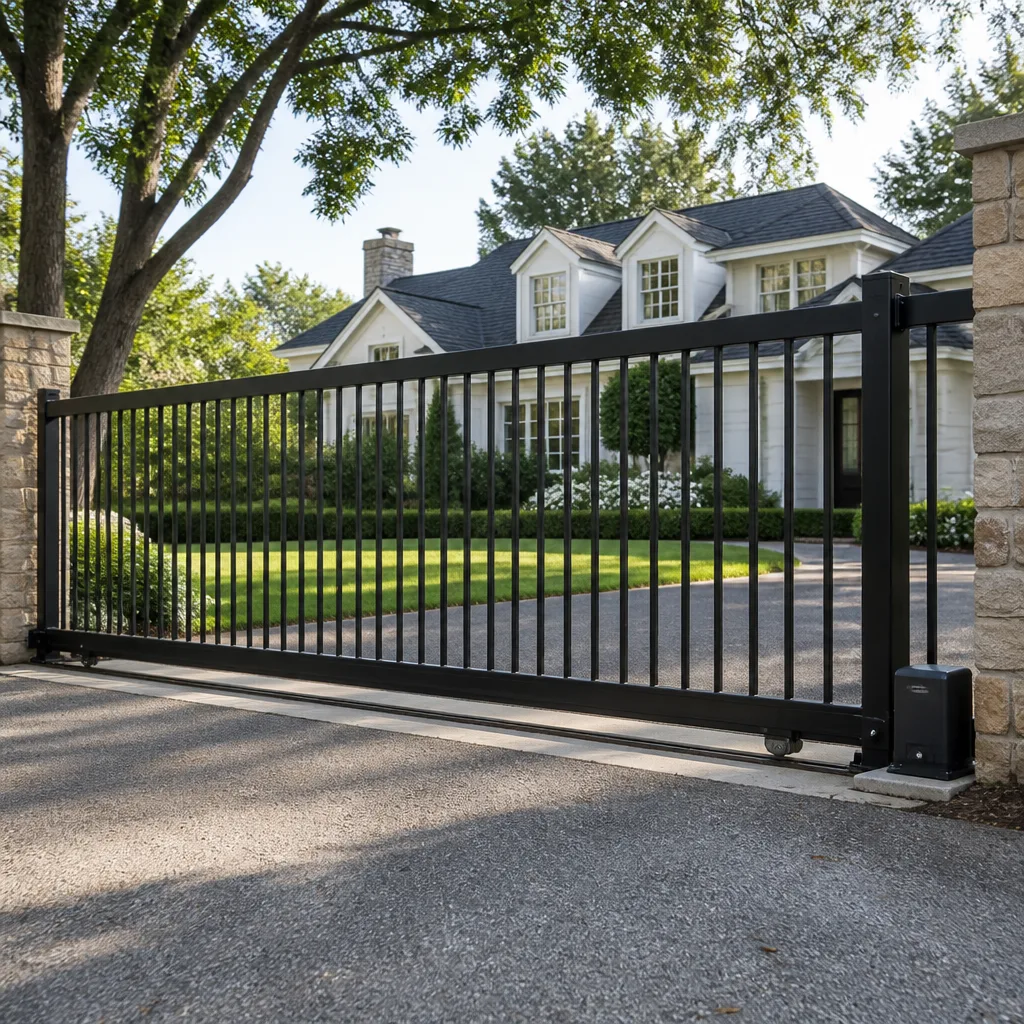
Slide gates ride on wheels that roll along a track, and those wheels are consumable items. They’re designed to wear and be replaced. When you can see the wheels have developed flat spots, when you can see grooves worn into the track, or when you notice the gate sits lower in one section than another, the wheel assembly is at the end of its service life. In Calabasas, the dust factor is real. The same wind that keeps the air clean also keeps a fine layer of grit on every outdoor surface, and that grit accelerates wheel and track wear meaningfully compared to coastal or inland communities with heavier vegetation. Track and wheel replacement is routine maintenance, not a major repair, which is exactly why it should never become a major repair.
Automation Warning Signs: Opener Behavior That Spells Trouble
The automation side of a gate system has its own warning language, and it’s different from the mechanical side. These are electrical and electronic symptoms that homeowners often misread as low batteries or remote problems when they’re actually the opener telling you something is failing.
The Gate Opens But Won’t Close (or Closes But Won’t Open)
One-direction operation is almost never a motor problem. The motor is doing half its job. The issue is almost always in the control logic or the safety inputs. The most common cause is a photo-eye or safety edge that’s dirty, misaligned, or failing, sending a constant “obstruction detected” signal that prevents closing. The second most common cause is a limit switch that has failed in one direction, so the board never gets the signal that the gate reached the end of its open cycle and therefore never initiates the close. On DoorKing and FAAC operators, which are built for decades of service, one-direction operation is frequently traceable to a single limit switch or a single relay on the board, both of which are repairable without replacing the operator. The diagnostic step is simple: bypass the safety inputs one at a time and see if the gate will close. If it does, you’ve found the problem circuit. If it doesn’t, the board or limit switch is the culprit.
The Remote Range Has Gotten Noticeably Shorter
Remote-control range degradation happens gradually. Six months ago you could open the gate from the bottom of the driveway. Now you have to be within twenty feet. Most homeowners assume the battery is dying, and sometimes that’s accurate. But when new batteries don’t fix the range problem, the issue is usually the receiver antenna or interference from something that’s changed in the area. Calabasas has seen significant new home construction over the last decade, and new structures, new wireless networks, and new power lines can all affect gate remote range. The receiver antenna may be damaged, the receiver module may be aging, or the remote itself may have a failing transmitter chip. We diagnose range issues with a simple process: replace the battery, test a second remote, inspect the antenna, test at different points around the property. That sequence identifies the problem in under fifteen minutes in most cases.
The Gate Cycles On Its Own or Activates Randomly
Ghost cycling, where the gate opens or closes without anyone pressing a button, is usually one of three things: a failing underground loop detector, a stuck button on a keypad or remote, or radio frequency interference triggering the receiver. Underground loop detectors are the coils of wire buried in the driveway that sense vehicles and trigger the gate. When they age out, they can start firing randomly. Calabasas properties with long driveways often have multiple loop detectors, and when one starts to go, the gate may cycle every time a car passes nearby or at completely random intervals. The security concern here is obvious: a gate that opens on its own defeats the purpose of having a gate. This symptom warrants prompt attention, and the diagnostic process involves isolating each input to the control board until the cycling stops.
What Causes Gate Failure in Calabasas Specifically
Every region has its own gate-failure profile, the unique combination of climate, terrain, and construction patterns that determines which components fail first and why. After more than forty years working on gates in this area, we can describe the Calabasas failure profile with some precision.
Wind-Driven Dust and Grit
Calabasas sits against the western edge of the San Fernando Valley where the Santa Monica Mountains funnel wind through the passes. That wind picks up fine, abrasive dust from the dry hillsides and deposits it on every horizontal surface, including gate tracks, hinge pins, and opener internals. Coastal properties don’t see this level of airborne grit. Valley-floor properties see some. Calabasas sees more, because the mountain proximity means stronger wind gusts and finer particulates. The practical effect is that bearings, wheels, and tracks in Calabasas wear faster than the manufacturer’s published service intervals would suggest. A wheel that might last eight years in another climate might last five here. That’s not a defect in the wheel. It’s the environment. And it’s why a seasonal tune-up that includes track cleaning and wheel inspection is worth the time, not an optional luxury.
Thermal Expansion Cycles
Calabasas summer days routinely reach the mid-90s, and winter nights can drop into the low 40s. That’s a fifty-plus-degree annual temperature swing, and metal responds to it. A 16-foot steel gate can expand and contract by a measurable fraction of an inch across that temperature range. Over years of cycling, that expansion and contraction works bolts loose, shifts track alignment, and stresses welds. Gates that were installed and then never serviced eventually develop alignment problems not because the installation was bad but because the environment moved the metal. The remedy is periodic re-alignment and bolt re-torquing, which is exactly what our $89 seasonal tune-up covers.
Topography-Related Load Issues
Calabasas driveways are not flat. This is canyon country and hillside developments, and many gates in the area are installed on slopes or at angles that put uneven load on the hinge assemblies. A gate installed on a slope works against gravity in one direction and with gravity in the other, which means the motor and the hardware see asymmetric stress. Pads and posts shift on hillside soil. Retaining walls settle. That movement transfers into the gate hardware. Homes in neighborhoods like Calabasas Hills, Mulholland Heights, and the Park City area all contend with some degree of slope-related gate stress. When we install or repair a gate in these areas, we account for the slope in the hinge sizing and the opener torque settings, because a flat-ground specification won’t hold up on a hillside.
Early Repair vs. Late Repair: What Each Path Costs
The financial case for addressing gate warning signs early is straightforward, but it’s also invisible to most homeowners because nobody publishes a menu of what neglect costs. Here’s what these repairs actually run in Calabasas when caught early versus when the problem is allowed to progress.
| Warning Sign | Early Repair Cost | Late Repair Cost | What Happens In Between |
|---|---|---|---|
| Grinding noise from track or wheels | $120-$250 for track cleaning, wheel replacement, re-alignment | $800-$1,500+ for opener damage from overloading, possible gearbox failure | The motor works against increased friction on every cycle until it burns out |
| Gate sag at hinge side, minor | $200-$400 for hinge replacement and re-alignment | $1,200-$2,500+ for frame re-welding, post reinforcement, full hinge rebuild | The sag adds leverage to the failing hinge, ovalizing the bearing and cracking the weld |
| Humming with no movement | $75-$150 for capacitor replacement | $600-$1,800 for motor or full opener replacement | The stalled motor overheats the windings every time it hums |
| Gate slamming at end of travel | $150-$300 for limit switch adjustment or hydraulic service | $500-$1,200 for cracked welds, damaged hinges, frame fatigue | Impact stress accumulates at the gate’s weak points with every slam |
| False safety reversals | $100-$200 for sensor cleaning or replacement | $700-$1,400 for control board issues after repeated false faults | The board’s open/close logic degrades with every false reversal |
The pattern is consistent. Early intervention on any of these warning signs costs a fraction of the late-stage repair. And the price difference isn’t just about parts, it’s about collateral damage: every cycle a compromised gate makes spreads the damage into adjacent components that would otherwise have been untouched.
What You Can Check Yourself vs. What Needs a Pro
There’s a reasonable middle ground between calling for every noise and ignoring everything until the gate fails. Here’s what a Calabasas homeowner can reasonably inspect and handle, and where the line is drawn.
What You Can Check Yourself
- Listen to the gate once a week. Stand at the driveway while the gate opens and closes. Note any change in pitch, rhythm, or volume. Changes over time are the warning sign.
- Look at the gate when it’s closed. Is the top rail level? Is the gap between the gate and the post even top to bottom? Is the gate touching the ground anywhere it shouldn’t?
- Clear debris from the track. Leaves, small stones, and built-up dust can be swept or blown out with no risk. This is simple preventative maintenance anyone can do.
- Check visible hardware. Look at the hinge bolts and mounting plates. If you see rust streaks running from any bolt, that’s a sign of moisture working into the connection.
- Test the safety features. Place an object in the gate’s path and verify it reverses. If it doesn’t reverse, stop using the gate and call for service immediately. A gate without functioning safety edges is dangerous.
What Needs a Trained Professional
- Anything involving the opener’s electrical components. Gate openers run on 110V or 220V line voltage. Opening the cover and probing around inside is a shock hazard and risks damaging the control board, which is frequently the most expensive component on the opener.
- High-tension springs and counterbalance systems. Some gate designs use torsion-style springs to offset the gate’s weight. These springs are under enormous tension and can cause serious injury if released improperly. This is work for a trained technician with the right tools.
- Hinge replacement or welding. When a gate sags, the hinge carries the full weight of the gate leaf, and removing it without proper support can cause the gate to drop suddenly. A 400-pound gate falling is not a risk worth taking.
- Any work on a gate that won’t hold position. If the gate won’t stay where you put it, it means the mechanical retention or the motor brake is failing. The gate is unstable, and that’s a hazard to work around.
Common Mistakes to Avoid
- Lubricating without cleaning first. Spraying lubricant on a dirty track or hinge creates a grinding paste that accelerates wear. Clean the surface before lubricating, and use the right product for the component. WD-40 is not a lubricant, it’s a water displacer, and it washes away the proper grease.
- Ignoring a noise because the gate still works. This is the most expensive mistake on the list. A gate that makes noise still works until the day it doesn’t, and that day is typically the one where you’re already late for something. The noise is the gate asking for a repair before the repair becomes urgent.
- Replacing the remote before checking the receiver. Homeowners in Calabasas spend money on new remotes every month when the actual problem is a failing receiver module or a dead antenna. A fifteen-minute diagnostic tells you which side of the system is actually failing.
- Adjusting limit switches without understanding the system. Limit switches control where the gate stops, and an incorrect adjustment can cause the gate to over-travel, under-travel, or fail to close properly. On older hydraulic operators, incorrect limit adjustment can also cause the relief valve to hammer, which is an unpleasant surprise the first time it happens.
- Propping a gate open or closed with improvised supports. A gate that won’t hold position has a mechanical failure that’s only getting worse. Using a cinder block or a bungee cord to keep it in place is a temporary patch that fails without warning, and a falling gate can damage vehicles, people, or the gate itself.
- Skipping seasonal maintenance entirely. The $89 seasonal tune-up exists because gates in this climate need periodic attention. Skipping it to save money is false economy: the tune-up catches the problems that turn into four-figure repairs.
- Hiring a generalist for gate work. General handymen will take a gate call, but gate automation is a specialized trade. The wiring, the force settings, the safety-edge integration, and the opener programming all require specific training. A wrong adjustment on a gate opener is not like a wrong adjustment on a door hinge. The stakes are higher.
When to Call a Professional
The shortest answer is: when you notice any of the warning signs above. But the practical answer is more specific. Call immediately if the gate has stopped holding position, if it’s reversing on its own without an obstruction, if it’s humming without moving, or if the safety reversal has stopped working. These are not scheduled-maintenance situations, they’re active failures that are causing additional damage or creating a safety risk every hour they continue.
Call within the week if the gate is grinding, sagging visibly, slamming at the end of travel, or if the remote range has shortened noticeably. These are progressive conditions that get more expensive the longer they run. Our team at Ironworks Gate Co. offers free estimates in Calabasas. If you’re hearing something unusual or the gate just doesn’t feel right, call (747) 308-3262. We’ll tell you honestly whether it needs attention now or whether it can wait, and that assessment costs you nothing.
Frequently Asked Questions
Gate repair in Calabasas typically ranges from $120 to $350 for common fixes like capacitor replacement, wheel replacement, track cleaning, and limit switch adjustment. Larger repairs, such as hinge rebuilds, frame welding, or opener replacement, can run from $500 to $2,500 depending on the gate’s size, weight, and the extent of the damage. Every job at Ironworks Gate Co. is priced upfront before any work begins, so the number you approve is the number on the invoice. For an exact quote on your gate, call (747) 308-3262.
A grinding gate is almost always caused by worn wheels, a contaminated track, or a gate that has dropped slightly and is dragging. In Calabasas, wind-blown dust and grit from the surrounding hills accelerate track and wheel wear, so grinding tends to appear earlier here than in other regions. The repair typically involves cleaning the track, replacing worn wheels, and re-leveling the gate. Call (747) 308-3262 and we’ll diagnose the exact cause, usually in under half an hour.
Most gate repairs are completed in a single visit. We stock common parts for LiftMaster, DoorKing, Elite, and Mighty Mule openers on our trucks, along with wheels, hinges, capacitors, and control components, so the technician has what’s needed to finish the job on the first trip. Our dispatch team works to get a truck to your Calabasas home quickly when the situation is urgent. Call (747) 308-3262 and we’ll give you a straight answer on when we can be there.
A full gate opener replacement in Calabasas typically runs between $1,200 and $3,500 installed, depending on the gate’s weight, the opener type, and the amount of existing wiring that can be reused. Light-duty openers for residential swing gates sit at the lower end of that range, while heavy-duty slide gate operators and hydraulic systems run higher. We service nine major opener brands and can recommend the right unit for your specific gate rather than pushing whatever we have in stock. For a written quote on openers that fit your gate, call (747) 308-3262.
As a rule, gates in Calabasas benefit from a seasonal tune-up every spring and fall. The two-service annual schedule catches alignment drift from thermal expansion, clears the dust and grit that accumulates during the windy season, and catches wear before it progresses. We offer an $89 seasonal tune-up that covers the inspection and adjustment of all critical components including hinges, track, wheels, safety sensors, and opener settings. A gate on a twice-yearly service schedule is dramatically less likely to fail without warning.
The most common gate openers we see in Calabasas are LiftMaster, DoorKing, Elite, FAAC, and Viking. The area has a mix of older estates with hydraulic operators from the 1980s and 1990s and newer homes with modern swing and slide openers. Our technicians are trained on nine major brands, which means whatever is on your driveway, we have the diagnostic equipment and the replacement parts to service it correctly on the first visit. If you know the brand of your opener but not the model, that’s fine, we’ll identify it when we arrive.
The Bottom Line
Gates in Calabasas have a hard job. The heat, the dust, the hills, and the daily cycling all take their toll. But a well-maintained gate gives decades of reliable service, and the maintenance is neither expensive nor complicated. The key is paying attention to the warning signs: the sound of a wheel dragging in a gritty track, the visible sag of a hinge that’s working too hard, the hum of a capacitor that’s given up, the slam of a gate that’s lost its deceleration. Every one of those signals is an opportunity to fix a small problem before it becomes a large one. At Ironworks Gate Co., we’ve been serving Calabasas homeowners for over 42 years, and we stand behind every job with our written 90-Day Done Right Promise. When you’re ready for someone to take a look, call (747) 308-3262. A live person answers, day or night, and the estimate is free.
Written by Victor Salinas, Owner at Ironworks Gate Co., serving Calabasas since 2013.