
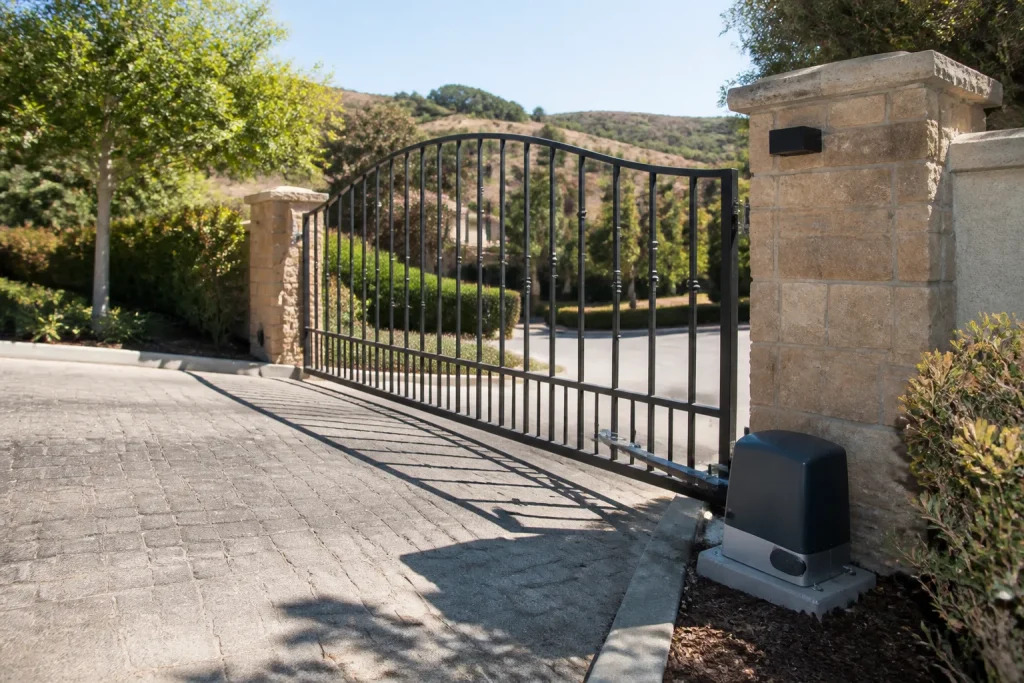
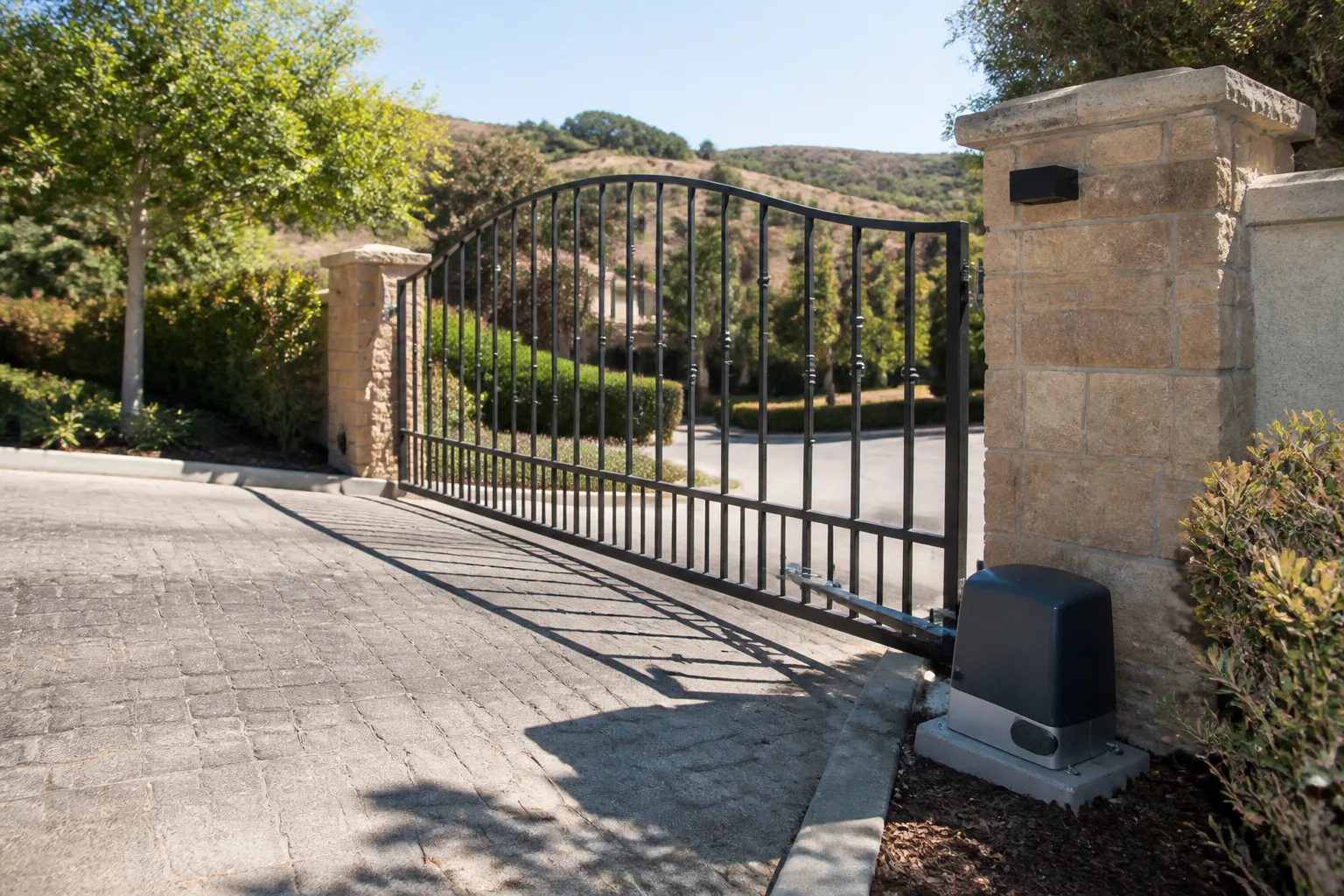
FAAC Gate Repair in Calabasas: A Homeowner’s Guide
Most FAAC gate repairs in Calabasas don’t require a new motor. They require a technician who knows the difference between a $40 logic board capacitor and a $1,200 hydraulic pump replacement. A generalist will quote you the pump. We fix the capacitor, and your gate runs another eight years. If you’d rather not sort through error codes yourself, call (747) 308-3262 and we’ll walk you through it over the phone before anyone rolls a truck.
FAAC’s hydraulic swing-gate openers are among the most reliable units on the market. That reliability is exactly why Calabasas homeowners ignore the early warning signs until the gate stops mid-swing during a dinner party and the caterer can’t get out. By the time we arrive, the problem has usually been building for months: a sluggish open, a faint whine, a gate that pauses for half a second before reversing. Those small signals are the gate telling you something specific. This guide explains what those signals mean, what they cost to fix, and which ones you can safely check yourself before paying a dispatch fee.
What FAAC Gate Repair Actually Costs in Calabasas
FAAC gate repair in Calabasas typically runs between $240 and $680 for most electronic and hydraulic issues. A full hydraulic motor replacement runs higher, $1,400 to $2,900 depending on the model and whether the gate is single or double leaf. What surprises most homeowners is not the total. It’s the gap between what a knowledgeable FAAC technician charges to fix the real problem and what a generalist charges to replace the wrong part.
Here’s what we see on FAAC units across Calabasas, from Hidden Hills to Mulholland Heights:
- Logic board repair (capacitor, relay, or fuse replacement): $180-$320. This fixes most “dead gate” and “gate won’t close” calls. Parts are on our trucks.
- Hydraulic fluid flush and seal replacement: $260-$480. Southern California heat cycles degrade FAAC hydraulic seals faster than the manufacturer’s 2-year service interval suggests. More on this below.
- Limit switch adjustment or replacement: $140-$260. The gate stops short, over-travels, or slams. A 30-minute fix when caught early.
- Photocell (obstacle sensor) replacement: $160-$240. FAAC photocells are sensitive to direct afternoon sun in Calabasas, which causes false obstruction trips.
- Full hydraulic pump or motor assembly: $1,400-$2,900. It’s rare. We quote this only after we’ve ruled out the board, the fluid, and the seals, and we show you the test results before you approve a dollar.
Every price is quoted and agreed before any work starts. If the quote is $580, the invoice is $580. That’s how we’ve run Ironworks Gate Co. home for over 42 years, and it’s the only way we know to do business with neighbors who’ve lived here for two decades and plan to stay for two more.
The Three FAAC Failure Signatures Most Calabasas Technicians Misdiagnose
FAAC systems fail in brand-specific ways. LiftMaster problems look like LiftMaster problems. DoorKing problems look like DoorKing problems. And FAAC problems are almost always one of three things: a board fault, a hydraulic fluid issue, or a limit switch that drifted out of adjustment. A technician who works on all brands equally understands this. A technician who only sees one FAAC unit a month reaches for the motor replacement because it’s the easiest answer, not the right one.
Signature #1: The gate opens fine but stalls halfway closed
This is the board, not the motor. On FAAC 400 and 402 series control boards, a failing logic capacitor causes intermittent voltage drops to the motor relay. The gate starts closing, loses power for a split second, and the board interprets the stall as an obstruction. The gate reverses. Homeowners describe it as “the gate thinks something is in the way, but nothing is.” A generalist replaces the photocells, then the motor, and the gate still stalls because the capacitor was never tested. We replace the capacitor, test the board under load, and the gate closes like the day it was hung. Cost: under $300, one visit.
Signature #2: A faint whine on hot days, slower operation in summer
FAAC hydraulic units use pressurized fluid to move the gate. In Calabasas, where summer temperatures regularly push into the high 90s and the gate housing bakes in direct sun, thermal expansion stresses the pump seals. After five to seven years, those seals micro-fracture. Fluid weeps out slowly, air enters the system, and the pump cavitates: that’s the whine. The gate still opens, so homeowners ignore it. But running a FAAC hydraulic pump low on fluid is like running a car engine low on oil. The manufacturer’s 2-year service interval assumes a mild climate. In Los Angeles County heat, we recommend a fluid check every 18 months. A $280 seal and flush prevents a $1,900 pump replacement. We’ve pulled FAAC pumps out of gates in Calabasas Park Estates that were bone dry, and the homeowner said the gate “sounded a little funny for a while.”
Signature #3: The gate slams at the end of its travel, or stops six inches short
That’s a limit switch problem. FAAC limit switches are mechanical components that tell the board where the gate stops. Vibration from daily cycling, plus the small ground shifts common in Calabasas hillside neighborhoods, move them out of position. The gate over-travels and slams into the post, or under-travels and leaves a gap. The fix is a limit switch adjustment or replacement, not a new motor. We see this most often on gates that were installed ten or more years ago, before the current owners bought the house. The gate has been out of adjustment for so long that everyone assumes “it’s always done that.” It shouldn’t, and it doesn’t have to.
Reading FAAC Error Codes Before You Call Anyone
FAAC boards communicate through a series of LED blink patterns. You don’t need to be an electrician to read them, and knowing what the board says before you call a repair company in Calabasas puts you ahead of the conversation. Here’s what the most common patterns mean:
- Steady green LED: Board has power, system normal. If the gate won’t move with a steady green, the problem is the remote, the keypad, or the manual release is engaged.
- One blink, pause, repeat: Photocell obstruction or misalignment. Check for overgrown bougainvillea or a car parked in the sensor’s path. Calabasas landscaping is gorgeous and it’s the #1 cause of false trips.
- Two blinks, pause, repeat: Limit switch fault. The board can’t find the gate’s position. This needs a technician, but it’s a 30-minute fix, not a motor replacement.
- Three blinks, pause, repeat: Motor or hydraulic circuit fault. This is the one that could indicate a real motor problem, but a good FAAC technician tests the motor directly before condemning it. We’ve seen three-blink codes caused by nothing more than a loose spade connector.
- No LED at all: Power failure at the board. Check the breaker and the GFCI outlet. If those are fine, it’s a board fuse or the transformer. Both are stock repair parts, not a replacement board.
On the 615 series (common on newer Calabasas installations), the board uses a small digital display instead of blink codes. Error 12 means photocell fault. Error 23 means motor thermal trip, which often resets after 15 minutes. Error 30 is a board communication fault that generally means your wired keypad has a short from sprinkler water infiltration. Each of these is fixable at a fraction of the cost of a new operator.
Authorized FAAC Service vs. a General Gate Repair Company
The practical difference in Calabasas comes down to hydraulic fluid, not a badge. FAAC hydraulic units require a specific viscosity fluid: FAAC XT-220 or an approved equivalent. Using automatic transmission fluid from the auto parts store works for about 90 days, then the seals swell, the pump overheats, and the manufacturer voids the warranty. A general gate repair company that doesn’t stock FAAC parts and fluids will use whatever hydraulic oil is on the truck, and you’ll be calling someone else in six months to replace the pump they destroyed.
We carry FAAC-compatible fluids and genuine FAAC repair parts on our trucks because we service these units in Calabasas every week. The battery-backed boards for Fire Department emergency access, the 115V transformers, the limit switch cams, the hydraulic seal kits: if your FAAC 400 or 615 needs it, it’s probably on the truck before we even see the gate. That’s the advantage of a company that works on these systems constantly rather than occasionally.
We also service Ghost Controls, DoorKing, Elite, and Mighty Mule systems, so when a Calabasas homeowner has a mixed installation or an older unit from a brand that’s no longer made, we can cross-reference parts across brands. That breadth means fewer return visits and fewer “we’ll have to order that” phone calls.
The Five-Minute FAAC Checklist Before You Pay a Dispatch Fee
Half of the FAAC service calls we take in Calabasas are resolved over the phone with this list. If the gate has power and the manual release isn’t engaged, a human with a flashlight can check the rest. Do these in order:
- Check the breaker and the GFCI. FAAC operators plug into a standard outlet or run through a dedicated breaker. A tripped GFCI, especially after rain or sprinkler overspray in Calabasas yards, kills the whole gate. Reset it and test.
- Confirm the manual release isn’t pulled. FAAC units have a manual release handle or key, usually on the operator housing. If a kid pulled it, or a landscaper’s blower cord caught it, the gate disconnects from the motor and won’t move electronically. Re-engage it and test.
- Clear the photocells. Walk to each sensor, usually mounted near ground level on the gate posts. Wipe the lenses with a dry cloth. Move any parked car, trash bin, or overgrown plant out of the beam’s path. Retest.
- Look for the blinking LED. If the board has power and the sensors are clear, count the blinks per the patterns above. Write down what you see before you call. It saves the technician 20 minutes.
- Spray the hinges. A gate that binds on dry hinges draws more current, which trips the FAAC motor’s thermal overload. A quick shot of lithium grease on the hinge points, then retest. If the gate moves sluggishly but moves, call us: that’s a hydraulic issue, not a hinge issue.
If all five check out and the gate still won’t run, the problem is internal: board, motor, or hydraulic. That’s when to call a professional. A live person answers at (747) 308-3262, 24 hours a day, and we’ll tell you honestly over the phone whether it’s worth a service call or whether you saved yourself $95 by checking the GFCI. We’ve pulled a FAAC operator out of a garage over in Vista Pointe where the only problem was a tripped outlet the homeowner never knew existed, because the previous owner had it installed behind a potting bench. No charge for that phone call. We’d rather you trust us than bill you.
When to Call a Pro and When to Wait
Any FAAC issue involving the hydraulic pump, the control board’s internal components, or the high-pressure fluid lines should be handled by a trained technician. Hydraulic fluid under pressure can cause injury if a line is opened incorrectly, and the 400-series pump holds pressure even when the unit is unplugged. This is not a DIY project, and the warranty implications of opening a FAAC unit without knowing what you’re doing are real.
That said, a gate that opens slowly on a mild day but normally on a hot day is likely a partially obstructed sensor or a hinge that needs grease. That can wait a few days. A gate that won’t close at all is a security issue for a Calabasas home, and it needs attention that day. A gate that opens on its own in the middle of the night is a board receiving stray radio signals, and it also needs attention that day, because an open gate is an invitation. If it’s urgent, we run same-day service in Calabasas, and a live person answers the phone whether it’s Tuesday at noon or Saturday at 11pm.
For related work, see Gate Repair in Calabasas for the full scope of what we fix, or Gate Motor & Opener in Calabasas if your unit has reached the end of its service life and you’re weighing repair against replacement. If you’re starting fresh, Gate Installation in Calabasas covers the process from first measure to final walkthrough.
The Bottom Line
FAAC gate repair in Calabasas is usually faster and cheaper than homeowners expect, provided the technician actually works on FAAC systems regularly. The most common failures are board capacitors, hydraulic seals, and limit switches, and all three are repairable parts, not replacement items. Read the LED code before you call. Check the GFCI, the manual release, and the sensors. And if the gate still won’t cooperate, call someone who will tell you the truth about what’s wrong, even when the truth is a $40 capacitor instead of a $1,900 pump.
If you’re in Calabasas and your FAAC gate is acting up, call Ironworks Gate Co. at (747) 308-3262. Estimates are free, every price is agreed before work starts, and every repair carries our written 90-Day Done Right Promise. If it’s not right, we come back and make it right. No paperwork, no arguing. That’s the deal, and we’ve stood behind it for over 40 years.
Frequently Asked Questions
Most FAAC gate repairs in Calabasas cost between $240 and $680, depending on whether the issue is electronic, hydraulic, or mechanical. A full hydraulic motor replacement runs $1,400 to $2,900. We quote the exact price before any work begins, and that price doesn’t change. Call (747) 308-3262 for a free estimate on your specific unit.
Yes, for most board, limit switch, and sensor issues. We stock common FAAC repair parts on our trucks, so a single-visit fix is the norm, not the exception. If your unit needs a part that isn’t stocked, we’ll tell you the lead time before we leave the driveway. Call (747) 308-3262 and describe the LED code or symptom, and we’ll tell you what to expect.
Any gate company with genuine FAAC experience and the correct hydraulic fluid can service these units properly. The risk with a generalist is mismatched fluid and misdiagnosis. FAAC hydraulic units require specific fluid, and using the wrong type voids the warranty and ruins the pump. We service FAAC, Ghost Controls, DoorKing, Elite, and Mighty Mule systems regularly, and we carry the correct fluids and parts for each.
Stray radio interference from a neighboring gate remote, a garage door opener on a nearby frequency, or a failing receiver board can trigger phantom openings. FAAC units on older 390 MHz receivers are more prone to this. The fix is usually a receiver board swap or a frequency reassignment, not a new motor. Call (747) 308-3262 and we’ll help you isolate the source.
Written by Victor Salinas, Owner at Ironworks Gate Co., serving Calabasas since 2013.
Need Gate Repair Help?
Call Ironworks Gate Co. - licensed & insured, here with fast after-hours help in Calabasas.
(747) 308-3262